
ในเหตุการณ์เพลิงไหม้ที่เกิดขึ้นอย่างกะทันหันภายในที่พักอาศัย ความแตกต่างระหว่างความเสียหายเล็กน้อยกับหายนะที่สูญเสียทั้งชีวิตและทรัพย์สิน มักขึ้นอยู่กับความเป็นมืออาชีพและการวางแผนกลยุทธ์ที่แม่นยำ หากคุณเป็นเจ้าของบ้าน ผู้พักอาศัย หรือบุคลากรที่ดูแลความปลอดภัย คุณเคยสงสัยหรือไม่ว่าทีมดับเพลิงมืออาชีพเขามี รูปแบบการดับเพลิงโครงสร้างบ้านเดี่ยว และประสานงานกันอย่างไรจึงสามารถควบคุมเพลิงโหมกระหน่ำในห้องครัวหรือห้องนั่งเล่นได้อย่างรวดเร็ว? การทำความเข้าใจหลักการ Coordinated Fire Attack หรือการโจมตีเพลิงแบบประสานสอดคล้อง ตามผลการศึกษาวิจัยภาคสนามระดับโลกจาก UL FSRI (Fire Safety Research Institute) ถือเป็นกุญแจสำคัญที่จะช่วยยกระดับความปลอดภัย บทความนี้จะพาท่านเจาะลึกวิเคราะห์การจับคู่กลยุทธ์การใช้น้ำและการระบายอากาศในบ้านพักอาศัยตามมาตรฐานสากล NFPA (National Fire Protection Association) เพื่อให้คุณเข้าใจกระบวนการระงับอัคคีภัยและนำไปประยุกต์ใช้ในการป้องกันภัยได้อย่างมีประสิทธิภาพสูงสุด
Key Takeaways: จุดสำคัญที่ต้องรู้
- ความสำคัญของการประสานงานในบ้านพักอาศัย: การโจมตีเพลิง (Fire Suppression) และการระบายอากาศ (Ventilation) ในโครงสร้างบ้านเดี่ยวต้องทำควบคู่กันอย่างสอดคล้อง หากทำแยกส่วนอาจทำให้ไฟโหมรุนแรงขึ้น
- ข้อมูลเชิงประจักษ์จากงานวิจัยบ้านจริง: การทดลองจุดไฟเผาบ้านเดี่ยวของจริง (Acquired Single-Family Structures) ช่วยพิสูจน์ผลลัพธ์การใช้น้ำและแรงดันก๊าซร้อนได้อย่างแม่นยำกว่าการคาดเดา
- การรักษาพื้นที่ปลอดภัยสำหรับผู้ประสบภัย: การประสานงานที่รวดเร็วและถูกจังหวะช่วยลดความเข้มข้นของก๊าซพิษและรักษาพื้นที่รอดชีวิต (Survivable Space) ให้แก่คนในครอบครัวที่ติดค้างภายในบ้าน
ทำความเข้าใจแก่นแท้ของ Coordinated Fire Attack กับรูปแบบการดับเพลิงโครงสร้างบ้านเดี่ยว
ในอดีตยุทธวิธีของนักดับเพลิงมักขับเคลื่อนด้วยประสบการณ์บอกเล่า (Anecdotal Experience) ซึ่งบางครั้งอาจให้ข้อมูลที่ไม่ครบถ้วนสมบูรณ์เมื่อต้องเผชิญกับสภาพแวดล้อมในบ้านยุคใหม่ ตามคำแนะนำของสถาบันระดับโลกอย่าง IFSTA การเปลี่ยนผ่านสู่ยุควิทยาศาสตร์ความปลอดภัยสมัยใหม่ทำให้เราต้องศึกษาข้อมูลเชิงปริมาณ (Quantifying the Fire Ground) เช่น อุณหภูมิ (Temperature) การแผ่รังสีความร้อน (Heat Flux) และแรงดันก๊าซ เพื่อตอบคำถามว่า “ควรใช้น้ำเมื่อไหร่ ที่ไหน และอย่างไร” รวมถึง “ควรระบายอากาศก่อน ระหว่าง หรือหลังการเข้าโจมตี” เพื่อให้เหมาะสมกับ รูปแบบการดับเพลิงโครงสร้างบ้านเดี่ยว ในแต่ละกรณี
1. รายละเอียดเนื้อหาแบบสรุป: 3 รูปแบบการดับเพลิงและระบายอากาศในโครงสร้างบ้านเดี่ยวจากงานวิจัย
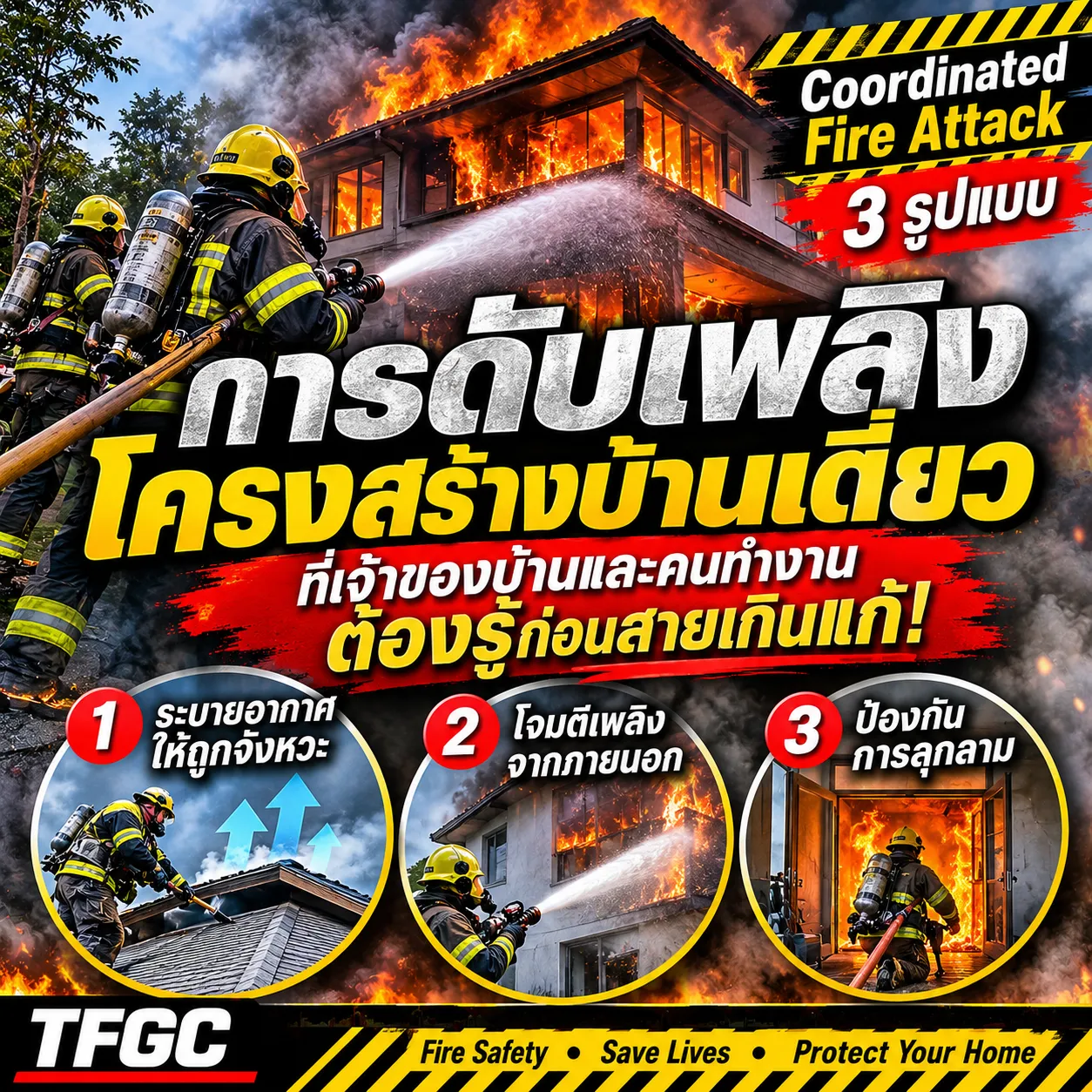
- รูปแบบที่ 1 การระบายอากาศแนวดิ่งเทียบกับการระบายอากาศเหนือโถงบันได (Vertical Ventilation Over Fire vs. Over Stairway): ทีมวิจัยได้ทดสอบในบ้านจริงบนถนน Water Street โดยเปรียบเทียบการเจาะหลังคาเหนือจุดเกิดเหตุโดยตรงกับการเปิดระบายอากาศบริเวณเหนือโถงบันได พบว่าการเปิดช่องระบายอากาศให้ตรงตำแหน่งเพลิงไหม้พร้อมกับการส่งแนวสายน้ำเข้าควบคุม จะช่วยดึงความร้อนและควันพิษออกจากเส้นทางอพยพได้มีประสิทธิภาพสูงสุด
- รูปแบบที่ 2 การโจมตีเพลิงแบบเปลี่ยนผ่านควบคู่การระบายอากาศแนวนอน (Transitional Attack with Horizontal Ventilation): จากการทดสอบเหตุเพลิงไหม้ห้องครัวด้านหลังบ้าน (บนถนน North Walnut และ Broadway) นักวิจัยพบว่าการฉีดน้ำจากภายนอกหน้าต่างเข้าไปลดอุณหภูมิห้องอย่างรวดเร็ว (Transitional Attack) ก่อนส่งทีมบุกเข้าไปด้านใน ควบคู่กับการเปิดหน้าต่างระบายอากาศแนวนอนหรือใช้พัดลมแรงดันบวก (Positive Pressure Ventilation) ช่วยลดโอกาสการเกิด Flashover และลดความเสี่ยงต่อผู้ประสบภัยที่ติดอยู่ในบ้านได้อย่างชัดเจน
- รูปแบบที่ 3 การโจมตีจากภายในพร้อมการระบายอากาศด้วยแรงน้ำ (Interior Attack with Post-Ventilation & Hydraulic Leveling): ในการทดสอบบนถนน Wapakoneta และเมือง Beavercreek ซึ่งจำลองเหตุเพลิงไหม้ห้องครัวจนถึงจุด Flashover แล้วเปิดประตูหน้าบ้าน ตามด้วยหน้าต่างบานหน้าในอีก 10 วินาทีถัดมา ก่อนส่งทีมดับเพลิงเข้าโจมตีภายใน พบว่าการประสานจังหวะเวลา (Timing) ระหว่างการเปิดประตู เปิดหน้าต่าง และการใช้แรงน้ำช่วยขับดันก๊าซร้อน (Hydraulic Ventilation) สามารถลดอุณหภูมิและก๊าซพิษลงได้อย่างรวดเร็ว
การแก้ปัญหาเฉพาะเหตุการณ์: วิธีรับมือเมื่อ “เกิดเพลิงไหม้ในห้องครัวบ้านเดี่ยว และคุณต้องตัดสินใจระหว่างเปิดหน้าต่างระบายควันหรือปิดประตูหนีไฟ”
ในสถานการณ์หน้างานจริง หากเกิดเพลิงไหม้ขึ้นภายในบ้านเดี่ยวหรือที่พักอาศัยของคุณ และคุณต้องเผชิญกับกลุ่มควันหนาแน่น ประสบการณ์และความรู้จากผู้เชี่ยวชาญด้านความปลอดภัยมีแนวทางปฏิบัติเพื่อเอาชีวิตรอดดังนี้ครับ:
- กรณีเกิดเพลิงไหม้ห้องครัวและควันพุ่งเต็มชั้นล่างของบ้าน: “ห้ามเปิดหน้าต่างหรือประตูทิ้งไว้สุ่มสี่สุ่มห้าเด็ดขาด” เพราะการเปิดช่องระบายอากาศโดยไม่มีสายน้ำดับเพลิงควบคุม จะสร้างช่องทางการไหลของอากาศ (Flow Path) ดึงออกซิเจนเข้ามาป้อนไฟ ทำให้เปลวไฟลุกวาบขยายวงกว้างไปทั่วบ้านอย่างรวดเร็ว ให้เน้นปิดประตูห้องครัวหรือประตูห้องนอนเพื่อกั้นควัน (Close Before You Doze) และรีบอพยพออกนอกตัวบ้านทันที
- กรณีต้องใช้ถังดับเพลิงเคมีหรือสายยางฉีดน้ำในระยะเริ่มต้น: หากเพลิงยังอยู่ในวงจำกัดและมีทางหนีไฟด้านหลังที่ปลอดภัย ให้ฉีดสารดับเพลิงหรือน้ำไปที่ฐานของเปลวไฟโดยตรงอย่างรวดเร็ว พร้อมทั้งสังเกตระดับควันและความร้อน หากไฟลุกลามเกินกว่าจะควบคุมได้ใน 10 วินาที ให้ทิ้งอุปกรณ์แล้วอพยพพร้อมโทรแจ้ง 199 ทันที
หลักการทางวิทยาศาสตร์และกลศาสตร์ของของไหล (Thermodynamics & Fire Dynamics)
การวิเคราะห์ทางวิทยาศาสตร์จากห้องปฏิบัติการและสนามทดสอบจริงอธิบายกลไกการประสานงานดับเพลิงในเชิงฟิสิกส์ได้อย่างชัดเจน:
- การวัดค่าพลังงานความร้อน แรงดัน และก๊าซพิษ (Heat Flux, Pressure & Gas Sensors): ทีมวิจัยจาก UL FSRI และสถาบัน Illinois Fire Service Institute ได้ติดตั้งเซนเซอร์ตรวจวัดอัตราการแผ่รังสีความร้อน แรงดันอากาศ รวมถึงก๊าซไฮโดรเจนไซยาไนด์ (HCN) คาร์บอนมอนอกไซด์ (CO) และออกซิเจน ทำให้เห็นว่าเมื่อเปิดช่องระบายอากาศอย่างประสานสอดคล้องกับสายน้ำ ความดันก๊าซร้อนจะถูกระบายออกสู่ภายนอกทันที ช่วยลดอุณหภูมิภายในห้องลงสู่ระดับที่มนุษย์สามารถรอดชีวิตได้
- การประเมินการบาดเจ็บของผิวหนังและขีดจำกัดชุดป้องกัน (Pigskin Assessment & Instrumented Helmets): การทดสอบการเผาไหม้บนผิวหนังจำลอง (Pigskin Assessment System) ร่วมกับระบบเลเซอร์วัดความชื้นและหมวกนิรภัยติดเซนเซอร์ ช่วยยืนยันว่าจังหวะเวลาการระบายอากาศที่คลาดเคลื่อนเพียง 10-20 วินาที สามารถเพิ่มระดับความร้อนสะสมจนทะลุขีดจำกัดความปลอดภัยของชุดผจญเพลิง (PPE) ได้
การปรับประยุกต์ใช้เพื่อความปลอดภัยในโรงงานอุตสาหกรรมและอาคารสูง
แม้กรณีศึกษาจะเน้น รูปแบบการดับเพลิงโครงสร้างบ้านเดี่ยว แต่หลักการสำคัญของ Coordinated Fire Attack สามารถนำมาปรับประยุกต์ใช้ในพื้นที่โรงงานอุตสาหกรรม คลังสินค้า หรืออาคารสูงในนิคมอุตสาหกรรมมาบตาพุด จังหวัดระยอง ได้อย่างมีประสิทธิภาพ:
- การบูรณาการแผนฉุกเฉินร่วมกับทีมกู้ภัยภายนอก: โรงงานและสถานประกอบการควรจัดทำแผนซ้อมรบจำลองสถานการณ์ (Tabletop & Field Exercises) ร่วมกับหน่วยดับเพลิงท้องถิ่น เพื่อให้ทุกฝ่ายเข้าใจขั้นตอนการประสานงานการใช้น้ำและการเปิดระบบระบายควัน (Smoke Control) ให้สอดคล้องกัน
- การปฏิบัติตามกฎหมายความปลอดภัย: การบริหารจัดการระบบป้องกันอัคคีภัยและการฝึกอบรมทีมดับเพลิงประจำสถานประกอบการต้องสอดคล้องกับข้อกำหนดและกฎกระทรวงของสถาบัน TOSH เพื่อสร้างความมั่นใจในความปลอดภัยสูงสุดแก่พนักงานทุกคน
คำถามเช็กความเข้าใจในการปฏิบัติงาน (Safety Check Quiz)
- ตามหลักการ Coordinated Fire Attack ในโครงสร้างบ้านเดี่ยว การระบายอากาศและการโจมตีเพลิงควรปฏิบัติอย่างไรเพื่อให้เกิดประสิทธิภาพสูงสุด?
- เพราะเหตุใดการเปิดหน้าต่างระบายควันในบ้านเดี่ยวที่กำลังเกิดเพลิงไหม้โดยไม่มีน้ำควบคุมจึงเป็นอันตรายถึงชีวิต?
- จากการทดลองจุดไฟเผาบ้านจริง (Full-Scale Experiments) ก๊าซพิษชนิดใดบ้างที่นักวิจัยตรวจวัดควบคู่กับอุณหภูมิเพื่อประเมินโอกาสรอดชีวิตของผู้ประสบภัย?
เซกชัน FAQ: คำถามที่พบบ่อย
- Q1: Coordinated Fire Attack ในรูปแบบการดับเพลิงโครงสร้างบ้านเดี่ยวคืออะไร?
- A: คือยุทธวิธีและกระบวนการประสานงานระหว่างการใช้น้ำระงับเพลิง (ทั้งจากภายนอกและภายใน) ควบคู่กับการระบายอากาศ (แนวดิ่ง แนวนอน หรือแรงดันบวก) อย่างเป็นระบบและถูกจังหวะ เพื่อลดอุณหภูมิและช่วยชีวิตผู้ประสบภัยในบ้าน
- Q2: การฉีดน้ำจากภายนอกหน้าต่างเข้าไปในบ้าน (Transitional Attack) ช่วยลดอันตรายได้จริงหรือไม่?
- A: ช่วยได้จริงครับ ผลการทดลองในบ้านเดี่ยวของ UL FSRI ยืนยันว่าการฉีดน้ำจากภายนอกเข้าไปลดอุณหภูมิห้องต้นเพลิงก่อนทีมบุกเข้าด้านใน ช่วยชะลอการเกิด Flashover และเพิ่มโอกาสรอดชีวิตให้คนในบ้านได้อย่างมาก
- Q3: มาตรฐานสากลใดที่รองรับแนวทางการปฏิบัตินี้?
- A: ได้รับการศึกษาวิจัยภาคสนามและรับรองโดยสถาบันวิจัยระดับโลกอย่าง UL FSRI และบรรจุเป็นแนวทางปฏิบัติในมาตรฐานสากลของ NFPA
ศูนย์ฝึกอบรมความปลอดภัยและดับเพลิงมาตรฐานสากล TFGC
ศูนย์ฝึกอบรมความปลอดภัยและดับเพลิงมาตรฐานสากล TFGC (Tactical Fire Guard Training Center) ตั้งอยู่ในจังหวัดระยอง พร้อมให้บริการฝึกอบรมหลักสูตรความปลอดภัย อาชีวอนามัย และการระงับอัคคีภัยแก่ภาคอุตสาหกรรมในพื้นที่ภาคตะวันออก นิคมอุตสาหกรรมชลบุรี ระยอง และทั่วประเทศ
- จุดเด่นของเรา: เน้นการฝึกปฏิบัติจริงด้วยการจำลองสถานการณ์ทับซ้อน เพื่อให้ผู้เข้าอบรมได้ใช้ศักยภาพเต็มรูปแบบ ปรับเนื้อหาตามหน้างานจริง รองรับโรงงานยาง, น้ำมัน, โรงพยาบาล อาคารสูง รวมถึงกลุ่มนิคมอุตสาหกรรม ครอบคลุมหลักสูตรอบรมดับเพลิงขั้นต้น, อบรมดับเพลิงขั้นสูง, Petro Fire, Chemical Fire, Electric Fire, Fire Solar, Fire EV, Fire Watch และอบรมดับเพลิงเฉพาะทาง
- ช่องทางการติดต่อ:
- Website: https://tfgc-safety.com/
- LINE Official: https://lin.ee/VJZXUjD
- Facebook: TFGC Training Center
- TikTok: @tfgc.training_center
- Youtube: TFGC YouTube Channel
- เบอร์โทรติดต่อ: 099 939 5416
แหล่งอ้างอิงสากล: สถาบันส่งเสริมความปลอดภัย อาชีวอนามัย และสภาพแวดล้อมในการทำงาน (TOSH)
English Content Translation
Coordinated Fire Attack: 3 Single-Family Residential Firefighting Tactics Every Homeowner and Worker Must Know
During sudden residential fire emergencies, the margin between minor property damage and catastrophic loss of life and assets typically depends on professionalism and precise strategic planning. Whether you are a homeowner, resident, or safety officer, have you ever wondered how professional firefighters execute single-family residential firefighting tactics and coordinate their teams to rapidly control raging kitchen or living room infernos? Comprehending Coordinated Fire Attack principles based on landmark full-scale field research from UL FSRI (Fire Safety Research Institute) is paramount. This article explores and analyzes water application and ventilation strategies in residential structures under international NFPA (National Fire Protection Association) standards to empower readers with effective fire mitigation knowledge.
Key Takeaways
- The Necessity of Residential Coordination: Fire suppression and tactical ventilation in single-family residential structures must be executed synchronously; uncoordinated efforts can violently escalate fire intensity.
- Empirical Field Research in Acquired Homes: Full-scale experiments burning actual furnished single-family residences yield precise quantitative data regarding water impacts and thermal gas pressures surpassing legacy guesswork.
- Preserving Survivable Space for Occupants: Rapid, well-timed team coordination reduces toxic gas concentrations, maintaining viable survivable spaces for trapped family members inside the home.
Understanding the Core of Coordinated Fire Attack Versus Single-Family Residential Realities
Historically, firefighting tactics relied heavily on anecdotal experience, which frequently yielded incomplete operational descriptions when confronting modern residential fire environments. Per guidance from global organizations like IFSTA, transitioning into modern fire safety science requires quantifying fireground dynamics—such as temperature, heat flux, and gas pressures—to resolve fundamental questions regarding when, where, and how to apply water and execute tactical ventilation tailored to single-family residential firefighting tactics.
1. Summary of Detailed Content: 3 Single-Family Residential Suppression and Ventilation Patterns From Research
- Pattern 1: Vertical Ventilation Over Fire vs. Over Stairway: Researchers tested acquired structures on Water Street comparing roof cuts directly over the fire compartment versus venting over the stairwell. Venting directly over the fire paired with coordinated hose line advancement proved most effective at exhausting heat and toxic smoke away from egress paths.
- Pattern 2: Transitional Attack Paired With Horizontal Ventilation: In rear kitchen fire experiments (on North Walnut and Broadway), researchers demonstrated that applying water from an exterior window to rapidly cool the compartment (Transitional Attack) prior to interior entry, combined with horizontal window venting or positive pressure ventilation (PPV), significantly prevents flashover and improves occupant survivability.
- Pattern 3: Interior Attack With Post-Ventilation and Hydraulic Leveling: In tests on Wapakoneta and Beavercreek Township simulating post-flashover kitchen fires—opening the front door, taking the front window 10 seconds later, and advancing interior attack lines 10 seconds after that—synchronizing ventilation timing with hydraulic ventilation rapidly dropped interior temperatures and toxic gas levels.
Handling Unexpected Conditions: Managing Single-Family Kitchen Fires and Egress Ventilation Decisions
During actual residential emergencies, structured safety protocols dictate survival:
- Scenario: Kitchen Fires and Dense Smoke Filling the Ground Floor: “Never randomly leave windows or doors open.” Opening ventilation paths without charged hose lines controlling the fire creates flow paths pulling oxygen toward flames, triggering violent fire spread throughout the house. Close kitchen or bedroom doors to isolate smoke (“Close Before You Doze”) and evacuate immediately.
- Scenario: Deploying Fire Extinguishers or Garden Hoses in Incipient Stages: If fires remain small with clear exit routes behind you, discharge extinguishing agents or water directly at the base of flames while monitoring smoke and heat levels. If the fire outpaces control within 10 seconds, abandon suppression, evacuate, and call emergency services immediately.
Scientific Principles and Thermodynamics
Scientific analysis from laboratory and acquired structure tests clarifies physical fire suppression mechanics:
- Heat Flux, Pressure, and Toxic Gas Measurement: Researchers from UL FSRI and the Illinois Fire Service Institute instrumented test homes with heat flux, pressure, hydrogen cyanide (HCN), carbon monoxide (CO), and oxygen sensors, confirming that coordinated ventilation immediately exhausts high-pressure hot gases and restores survivable temperatures.
- Pigskin Assessment and Instrumented Helmets: Utilizing pigskin burn assessment systems, laser moisture sensors, and custom-instrumented firefighter helmets proved that ventilation timing discrepancies of merely 10 to 20 seconds can spike thermal exposure beyond protective gear (PPE) limits.
Adapting for Industrial Safety and High-Rises
Although these case studies focus on single-family residential firefighting tactics, the core principles of Coordinated Fire Attack adapt effectively to industrial plants, warehouses, and high-rises in industrial estates like Map Ta Phut, Rayong Province:
- Integrated Multi-Agency Emergency Planning: Facilities should conduct joint tabletop and field exercises with municipal fire departments to synchronize water application and smoke control ventilation procedures.
- Safety Law Compliance: Fire protection management and internal fire brigade training must align with ministerial regulations governed by TOSH guidelines to ensure maximum worker safety.
Safety Check Quiz
- According to Coordinated Fire Attack principles in single-family homes, how must ventilation and suppression be executed for maximum effectiveness?
- Why is opening windows to vent smoke in a burning single-family house without water control life-threatening?
- During full-scale acquired home experiments, which toxic gases did researchers measure alongside temperature to evaluate occupant survivability?
Common Operational Errors and Corrective Actions
- Error 1: Executing tactical ventilation in residential structures without established, charged hose lines ready for suppression.
- Impact: Uncontrolled oxygen introduction leading to rapid flashover acceleration.
- Corrective Action: Enforce strict suppression readiness prior to executing any vertical or horizontal ventilation per NFPA protocols.
- Error 2: Relying on anecdotal legacy assumptions rather than empirical fire research data.
- Impact: Flawed tactical decisions compromising firefighter and occupant safety.
- Corrective Action: Integrate UL FSRI research findings into standard operating procedures.
FAQ: Frequently Asked Questions
- Q1: What is a Coordinated Fire Attack in single-family residential firefighting?
- A: It is a systematic tactical process synchronizing exterior/interior water suppression with timed vertical, horizontal, or positive-pressure ventilation to lower temperatures and rescue trapped occupants.
- Q2: Does spraying water through an exterior window (Transitional Attack) truly reduce hazards?
- A: Yes. Full-scale UL FSRI residential experiments confirm that exterior water application rapidly cools the fire compartment before interior entry, delaying flashover and significantly increasing occupant survival odds.
- Q3: Which international standards govern these practices?
- A: Validated by premier research institutes such as UL FSRI and codified within NFPA standards.
Tactical Fire Guard Training Center (TFGC)
Tactical Fire Guard Training Center (TFGC), located in Rayong Province, provides professional safety, occupational health, and fire suppression training for industries across the Eastern region, Chonburi, Rayong, and nationwide.
- Our Strengths: Emphasis on practical hands-on training through multi-layered simulation technologies, adhering to international NFPA standards and customized to real workplace conditions—supporting rubber plants, oil facilities, hospitals, high-rise buildings, and industrial estates. Covering Basic Firefighting, Advanced Firefighting, Petro Fire, Chemical Fire, Electric Fire, Fire Solar, Fire EV, Fire Watch, and specialized firefighting courses.
- Contact Channels:
- Website: https://tfgc-safety.com/
- LINE Official: https://lin.ee/VJZXUjD
- Facebook: TFGC Training Center
- TikTok: @tfgc.training_center
- Youtube: TFGC YouTube Channel
- เบอร์โทรติดต่อ: 099 939 5416
International Reference: Thailand Institute of Occupational Safety and Health (TOSH)Fire Risk Assessment การประเมินความเสี่ยงด้านอัคคีภัย