
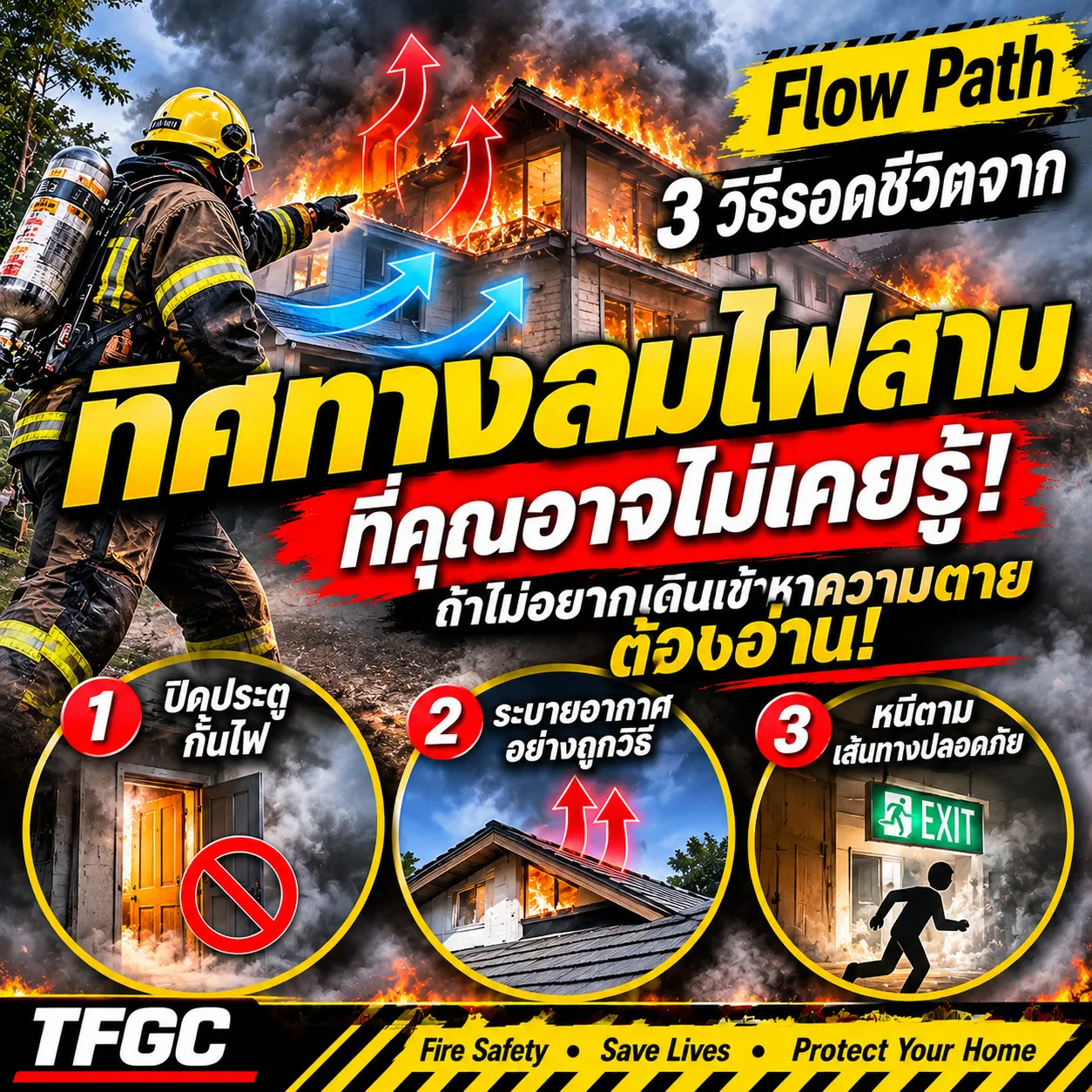
ในสถานการณ์เพลิงไหม้ที่เกิดขึ้นอย่างกะทันหันภายในบ้านพักอาศัยหรืออาคารสำนักงาน หลายคนมักตื่นตระหนกและวิ่งหนีเอาตัวรอดโดยปราศจากความเข้าใจเกี่ยวกับพฤติกรรมการเคลื่อนที่ของอากาศ คุณเคยสงสัยหรือไม่ว่าเหตุใดบางครั้งแค่การเปิดประตูหรือหน้าต่างเพียงบานเดียว จึงทำให้เปลวไฟโหมกระหน่ำพุ่งเข้าใส่ตัวคุณอย่างรวดเร็วราวกับมีคนเปิดเครื่องพ่นไฟ? คำตอบทั้งหมดซ่อนอยู่ภายใต้หลักการทางวิทยาศาสตร์ที่เรียกว่า Flow Path หรือเส้นทางการไหลของอากาศ ความร้อน และควันพิษ ตามผลการศึกษาวิจัยเชิงแอนิเมชันและห้องปฏิบัติการระดับโลกจาก UL FSRI และ UFRA (Utah Fire and Rescue Academy) บทความนี้จะพาท่านเจาะลึกวิเคราะห์กลศาสตร์ของไหล ความต่างของความดัน และทิศทางการลามของไฟตามมาตรฐานสากล NFPA (National Fire Protection Association) เพื่อยกระดับความปลอดภัย ปกป้องชีวิต และช่วยให้คุณสามารถประเมินสถานการณ์และเอาชีวิตรอดได้อย่างมืออาชีพ
Key Takeaways: จุดสำคัญที่ต้องรู้
- การเคลื่อนที่จากความดันสูงไปความดันต่ำ: ความร้อนและก๊าซจากการเผาไหม้จะขยายตัวและสร้างเขตความดันสูง ดันตัวเองให้เคลื่อนที่ไปหาพื้นที่ที่มีความดันต่ำหรือช่องเปิดที่มีออกซิเจน
- ลักษณะของเส้นทางการไหล (Bi-directional & Unidirectional Flow Paths): การไหลของอากาศมีทั้งแบบสวนทางกันในช่องเปิดเดียว (Bi-directional) และแบบทิศทางเดียวตลอดเส้นทาง (Unidirectional) ซึ่งส่งผลโดยตรงต่อความรุนแรงของไฟ
- อันตรายจากการเปิดช่องระบายอากาศผิดจังหวะ: การเจาะหลังคาหรือเปิดประตูตึกสูงอย่างไร้ทิศทาง สามารถเปลี่ยนเส้นทางลมและดึงเปลวไฟให้วิ่งผ่านห้องที่คุณอยู่ได้อย่างคาดไม่ถึง
ทำความเข้าใจแก่นแท้ของ Flow Path กับกฎฟิสิกส์ของการไหลของไฟ
ในทางวิศวกรรมความปลอดภัยและวิทยาศาสตร์อัคคีภัย Flow Path หมายถึงทิศทางการเคลื่อนที่ของความร้อน ควัน และอากาศ จากบริเวณที่มีความดันสูงไปยังบริเวณที่มีความดันต่ำทั้งภายในและภายนอกอาคาร ตามคำแนะนำของสถาบันระดับโลกอย่าง IFSTA เมื่อเกิดปฏิกิริยาการเผาไหม้ขึ้น พลังงานความร้อนจะทำให้อากาศขยายตัวและดันก๊าซร้อนพุ่งขึ้นสู่เพดานและขยายตัวออกด้านนอก ความดันที่เพิ่มสูงขึ้นนี้จะดันตัวลงมาเรื่อยๆ จนกระทั่งเจอช่องเปิด เช่น ประตูหรือหน้าต่าง เพื่อหาทางระบายออก ในขณะเดียวกัน แรงดันส่วนต่างนี้ก็จะทำหน้าที่ดึงดูดอากาศที่เย็นกว่าและอุดมด้วยออกซิเจนจากภายนอกให้ไหลเข้ามาหล่อเลี้ยงที่ฐานของเปลวไฟ เกิดเป็นวัฏจักรที่ทำให้ไฟเติบโตอย่างรวดเร็ว
1. รายละเอียดเนื้อหาแบบสรุป: รูปแบบและการเกิดเส้นทางการไหลของอากาศในอาคาร
- การไหลแบบสองทิศทาง (Bi-directional Flow Path): มักเกิดขึ้นในห้องปิดที่มีช่องเปิดเพียงช่องเดียว (เช่น ประตูหรือหน้าต่างที่เปิดอยู่) โดยอากาศเย็นที่มีความหนาแน่นสูงจะไหลเข้าสู่ส่วนล่างของช่องเปิด (Inlet) ในขณะที่ก๊าซร้อนและควันไฟจะลอยตัวพุ่งออกทางส่วนบนของช่องเปิดเดียวกัน (Outlet) ระนาบกั้นกลางระหว่างอากาศเข้าและออกนี้เรียกว่า ระนาบกลาง (Neutral Plane)
- การไหลแบบทิศทางเดียว (Unidirectional Flow Path): เกิดขึ้นเมื่ออาคารมีช่องเปิดหลายจุด เช่น การเปิดประตูด้านล่างของบ้านคู่กับการเจาะช่องระบายอากาศบนหลังคา (Vertical Ventilation) อากาศจะไหลเข้าทางประตูชั้นล่างและพุ่งขึ้นออกทางช่องบนหลังคาอย่างต่อเนื่อง หรือในกรณีอาคารหลายชั้นที่หน้าต่างชั้นบนแตก อากาศจะเข้าทางประตูล่างและพุ่งออกหน้าต่างชั้นบน
- เส้นทางการไหลที่ขับเคลื่อนด้วยกระแสลมพิเศษ (Wind-Driven & PPV Flow Paths): เมื่อลมธรรมชาติพัดปะทะหน้าต่างด้านรับลม (Windward Side) หรือเมื่อมีการใช้พัดลมระบายอากาศแรงดันบวก (Positive Pressure Ventilation – PPV) อย่างไม่ระมัดระวัง แรงลมจะบังคับให้ก๊าซร้อนและเปลวไฟพุ่งทะลักผ่านโถงทางเดินและห้องต่างๆ ไปยังฝั่งตรงข้ามอย่างรุนแรง
การแก้ปัญหาเฉพาะเหตุการณ์: วิธีรับมือเมื่อ “เกิดเพลิงไหม้ในอาคารและคุณต้องตัดสินใจเปิดประตูหรือหน้าต่าง”
ในสถานการณ์หน้างานจริง หากเกิดเพลิงไหม้ขึ้นภายในบ้านพักอาศัยหรืออาคารสูงที่คุณอยู่อาศัย ประสบการณ์และความรู้จากวิศวกรความปลอดภัยมีแนวทางปฏิบัติเพื่อเอาชีวิตรอดดังนี้ครับ:
- กรณีอยู่ภายในห้องปิดและสงสัยว่ามีไฟไหม้โหมกระหน่ำอยู่ด้านนอก: “ห้ามเปิดประตูบานนั้นในทันทีโดยไม่ใช้หลังมือสัมผัสความร้อน” หากคุณเปิดประตูออกไปในจังหวะที่เกิดเส้นทางการไหลแบบ Unidirectional หันเข้าหาตัวคุณ ห้องของคุณจะกลายเป็นทางผ่านของเปลวไฟและก๊าซร้อนทันที ให้ใช้ผ้าเปียกอุดร่องประตู และเลือกหนีทางหน้าต่างหรือระเบียงที่ปลอดภัยกว่า
- กรณีต้องเข้าช่วยเหลือผู้ประสบภัยหรือดับเพลิงเบื้องต้น: นักดับเพลิงมืออาชีพจะไม่เข้าจู่โจมสวนทางกับกระแสเส้นทางการไหลของก๊าซร้อน (Working against the Flow Path) เพราะจะทำให้ความร้อนพุ่งเข้าใส่ชุดป้องกันอย่างรุนแรง แต่จะเลือกเข้าโจมตีจากฝั่งที่รับอากาศเย็นเข้ามา (Working with the Flow Path) เพื่อให้ละอองน้ำไหลไปตามทิศทางลมพุ่งตรงสู่ ฐานเปลวไฟได้อย่างมีประสิทธิภาพ
หลักการทางวิทยาศาสตร์และกลศาสตร์ของของไหล (Fluid Dynamics & Pressure Differentials)
การอธิบายหลักการทางฟิสิกส์ช่วยให้เข้าใจพฤติกรรมของก๊าซและความดันในเชิงวิศวกรรม:
- พลศาสตร์ความดันส่วนต่าง (Pressure Differential Dynamics): อากาศร้อนมีมวลเบาและขยายตัว ทำให้เกิดความดันสูงบริเวณใต้เพดาน ส่วนอากาศเย็นภายนอกมีความดันสูงกว่าที่ฐานไฟ ความต่างของความดันนี้ (Pressure Gradient) เป็นแรงขับเคลื่อนหลักที่ควบคุมความเร็วและทิศทางการเคลื่อนที่ของ Flow Path
- การทดลองจำลองห้องควบคุม (Controlled Chamber Experiments): การทดลองจากศูนย์วิจัยของสำนักงานควบคุมแอลกอฮอล์ ยาสูบ และอาวุธปืนแห่งสหรัฐอเมริกา (ATF Fire Research Laboratory) พิสูจน์ให้เห็นว่า เมื่อเปิดประตูชั้นล่างและเปิดช่องระบายอากาศชั้นบน ทิศทางการไหลจะเปลี่ยนจาก Bi-directional เป็น Unidirectional ทันทีตามแรงลอยตัวของอากาศร้อน ซึ่งหากเจ้าหน้าที่ระบายอากาศบนหลังคาผิดจังหวะโดยไม่มีสายน้ำควบคุม ไฟอาจลุกลามเร็วกว่าเดิม
การปรับประยุกต์ใช้เพื่อความปลอดภัยในโรงงานอุตสาหกรรมและอาคารสูง
ในพื้นที่โรงงานอุตสาหกรรม คลังสินค้า หรืออาคารสำนักงานสูงในนิคมอุตสาหกรรมมาบตาพุด จังหวัดระยอง การประยุกต์ใช้ความรู้เรื่อง Flow Path มีแนวทางปฏิบัติที่สำคัญดังนี้:
- การติดตั้งระบบควบคุมควันและม่านกันไฟ (Smoke Management & Fire Curtains): ออกแบบอาคารให้มีระบบกั้นแบ่งโซน (Compartmentation) เพื่อป้องกันไม่ให้โถงบันไดหรือทางหนีฟังกกลายเป็นปล่องระบายก๊าซร้อนที่เชื่อมโยงทุกชั้นเข้าหากัน
- การซ้อมแผนอพยพและบริหารจัดการแรงดันอากาศ: กำหนดขั้นตอนการใช้ระบบระบายอากาศฉุกเฉินในโรงงานให้สอดคล้องกับทิศทางลมและตำแหน่งของทีมผจญเพลิง ตามข้อกำหนดของสถาบัน TOSH เพื่อความปลอดภัยสูงสุดของพนักงาน
คำถามเช็กความเข้าใจในการปฏิบัติงาน (Safety Check Quiz)
- ในทางวิทยาศาสตร์อัคคีภัย คำว่า Flow Path เกิดขึ้นจากการเคลื่อนที่ของสิ่งใดไปยังบริเวณใด?
- เพราะเหตุใดการเปิดประตูหรือหน้าต่างอย่างไร้ทิศทางในขณะเกิดเพลิงไหม้จึงเพิ่มความเสี่ยงอันตรายถึงชีวิต?
- การไหลของอากาศแบบ Bi-directional Flow Path มักเกิดขึ้นในลักษณะห้องที่มีลักษณะอย่างไร?
เซกชัน FAQ: คำถามที่พบบ่อย
- Q1: Flow Path สำคัญอย่างไรต่อการเอาชีวิตรอดจากไฟไหม้?
- A: ช่วยให้เราเข้าใจทิศทางการเคลื่อนที่ของควันและความร้อน ทำให้สามารถปิดประตูเพื่อกั้นเส้นทางลม หรือหลีกเลี่ยงการเปิดช่องทางที่อาจดึงเปลวไฟเข้าหาตัวได้
- Q2: ทำไมควันและความร้อนจึงพุ่งออกทางส่วนบนของประตูที่เปิดอยู่?
- A: เพราะก๊าซร้อนมีความหนาแน่นต่ำและขยายตัวสร้างความดันสูงบริเวณเพดาน จึงถูกดันให้ออกทางส่วนบน ในขณะที่อากาศเย็นภายนอกที่มีความดันสูงกว่าจะไหลเข้าทางส่วนล่าง
- Q3: มาตรฐานสากลใดที่รองรับการศึกษาเรื่องเส้นทางการไหลของไฟ?
- A: ได้รับการศึกษาวิจัยและรับรองโดย UL FSRI, UFRA และกำหนดเป็นแนวทางปฏิบัติในมาตรฐาน NFPA
ศูนย์ฝึกอบรมความปลอดภัยและดับเพลิงมาตรฐานสากล TFGC
ศูนย์ฝึกอบรมความปลอดภัยและดับเพลิงมาตรฐานสากล TFGC (Tactical Fire Guard Training Center) ตั้งอยู่ในจังหวัดระยอง พร้อมให้บริการฝึกอบรมหลักสูตรความปลอดภัย อาชีวอนามัย และการระงับอัคคีภัยแก่ภาคอุตสาหกรรมในพื้นที่ภาคตะวันออก นิคมอุตสาหกรรมชลบุรี ระยอง และทั่วประเทศ
- จุดเด่นของเรา: เน้นการฝึกปฏิบัติจริงด้วยการจำลองสถานการณ์ทับซ้อน เพื่อให้ผู้เข้าอบรมได้ใช้ศักยภาพเต็มรูปแบบ ปรับเนื้อหาตามหน้างานจริง รองรับโรงงานยาง, น้ำมัน, โรงพยาบาล อาคารสูง รวมถึงกลุ่มนิคมอุตสาหกรรม ครอบคลุมหลักสูตรอบรมดับเพลิงขั้นต้น, อบรมดับเพลิงขั้นสูง, Petro Fire, Chemical Fire, Electric Fire, Fire Solar, Fire EV, Fire Watch และอบรมดับเพลิงเฉพาะทาง
- ช่องทางการติดต่อ:
- Website: https://tfgc-safety.com/
- LINE Official: https://lin.ee/VJZXUjD
- Facebook: TFGC Training Center
- TikTok: @tfgc.training_center
- Youtube: TFGC YouTube Channel
- เบอร์โทรติดต่อ: 099 939 5416
แหล่งอองอิงสากล: สถาบันส่งเสริมความปลอดภัย อาชีวอนามัย และสภาพแวดล้อมในการทำงาน (TOSH)
English Content Translation
Flow Path: 3 Survival Rules From Fire Wind Directions You Must Know Or Risk Walking Into Death!
During sudden fire emergencies inside residential homes or commercial buildings, occupants frequently panic and flee without comprehending air movement behaviors. Have you ever wondered why occasionally opening a single door or window causes flames to surge toward you violently, mimicking a flamethrower? All answers reside within a physical principle known as Flow Path—the directional movement of heat, smoke, and air driven by pressure differentials. Based on landmark animated and laboratory research from UL FSRI and UFRA (Utah Fire and Rescue Academy), this article explores fluid mechanics, pressure variances, and fire propagation pathways under international NFPA (National Fire Protection Association) standards to elevate safety awareness and survival capabilities.
Key Takeaways
- Movement From High to Low Pressure: Combustion heat and gases expand, creating high-pressure zones that drive movement toward lower-pressure areas or oxygen-supplying openings.
- Flow Path Configurations: Airflow manifests as bi-directional exchanges through single openings or unidirectional streams across complex structures, dictating fire intensity.
- Hazards of Uncoordinated Venting: Untimely roof cuts or uncoordinated building openings alter wind paths, pulling flames through occupied compartments unexpectedly.
Understanding the Core of Flow Path Versus Fire Physics Realities
In fire safety engineering and fire science, Flow Path defines the directional pathway traveled by heat, smoke, and air between high- and low-pressure zones inside and outside structures. Per guidance from global organizations like IFSTA, combustion releases thermal energy causing gases to expand and rise. This rising pressure creates upper-level high-pressure reservoirs seeking egress points while simultaneously drawing cooler, oxygen-rich air into the base of fires, accelerating fire growth.
1. Summary of Detailed Content: Flow Path Mechanics and Configurations
- Bi-directional Flow Paths: Typically occurring in closed compartments with single openings, cooler dense air enters lower inlets while hot gases and smoke exit upper outlets of the same opening, separated by a neutral plane.
- Unidirectional Flow Paths: Manifesting when multiple openings exist (such as ground-level entry doors paired with vertical roof ventilation or upper-story window failures), air enters low and exits high in a continuous stream.
- Wind-Driven and PPV Flow Paths: Wind impacting windward openings or uncoordinated positive pressure ventilation (PPV) forces hot gases and flames through corridors and compartments toward leeward openings with extreme velocity.
Handling Unexpected Conditions: Managing Closed Compartments and Door Opening Decisions
During actual residential or commercial emergencies, structured safety protocols dictate survival:
- Scenario: Closed Rooms Suspected of External Fire Involvement: “Never open doors blindly without checking surface heat with the back of your hand.” Opening doors into active unidirectional flow paths directed toward your position transforms compartments into flame channels. Seal door gaps with wet fabric and seek alternative egress via windows or balconies.
- Scenario: Executing Initial Suppression or Rescue: Professional firefighters avoid working against flow paths, which forces hot gases directly into personal protective equipment (PPE). Instead, operators attack fires working with flow paths, allowing water mist to travel along air currents straight to fire origins.
Scientific Principles and Fluid Dynamics
Scientific principles clarify gas behavior and pressure mechanics:
- Pressure Differential Dynamics: Buoyant hot gases create elevated upper-room pressures, while higher exterior pressures drive lower-level airflow. This pressure gradient dictates Flow Path velocity and direction.
- Controlled Chamber Experiments: Research from the ATF Fire Research Laboratory demonstrates that opening lower doors and upper roof vents transitions bi-directional flows into unidirectional streams. Uncoordinated vertical venting without water control can exacerbate fire propagation.
Adapting for Industrial Safety and High-Rises
Within industrial plants, warehouses, or high-rise offices in industrial clusters like Map Ta Phut, Rayong Province, applying Flow Path principles involves key protocols:
- Smoke Management and Compartmentation: Design facilities with compartmentalized barriers and automated smoke evacuation systems to prevent stairwells and corridors from functioning as interconnected thermal flues.
- Emergency Evacuation and Ventilation Planning: Formulate emergency ventilation protocols aligned with prevailing winds and responder entry points per TOSH guidelines to safeguard personnel.
Safety Check Quiz
- In fire science, what physical phenomena establish a Flow Path between high- and low-pressure zones?
- Why does randomly opening doors or windows during active fires elevate life-threatening hazards?
- Under what compartment configuration does a Bi-directional Flow Path typically manifest?
Common Operational Errors and Corrective Actions
- Error 1: Forcing closed compartment doors without thermal checks during active fires.
- Impact: Exposing interior occupants or responders to sudden flame surges via active flow paths.
- Corrective Action: Enforce strict thermal door-checking protocols per NFPA guidelines.
- Error 2: Deploying uncoordinated tactical ventilation without active hose lines.
- Impact: Accelerating fire growth by supplying uncontrolled oxygen streams.
- Corrective Action: Synchronize tactical ventilation with charged attack lines.
FAQ: Frequently Asked Questions
- Q1: Why is Flow Path understanding vital for fire survival?
- A: It explains smoke and heat movement vectors, empowering individuals to close doors for wind isolation or avoid opening hazard vents.
- Q2: Why do smoke and heat exit through upper door openings?
- A: Low-density hot gases expand, creating upper-room high pressure that forces egress aloft, while denser exterior air enters below.
- Q3: Which international institutions validate flow path research?
- A: Validated by premier bodies such as UL FSRI and UFRA, and codified within NFPA standards.
Tactical Fire Guard Training Center (TFGC)
Tactical Fire Guard Training Center (TFGC), located in Rayong Province, provides professional safety, occupational health, and fire suppression training for industries across the Eastern region, Chonburi, Rayong, and nationwide.
- Our Strengths: Emphasis on practical hands-on training through multi-layered simulation technologies, adhering to international NFPA standards and customized to real workplace conditions—supporting rubber plants, oil facilities, hospitals, high-rise buildings, and industrial estates. Covering Basic Firefighting, Advanced Firefighting, Petro Fire, Chemical Fire, Electric Fire, Fire Solar, Fire EV, Fire Watch, and specialized firefighting courses.
- Contact Channels:
- Website: https://tfgc-safety.com/
- LINE Official: https://lin.ee/VJZXUjD
- Facebook: TFGC Training Center
- TikTok: @tfgc.training_center
- Youtube: TFGC YouTube Channel
- เบอร์โทรติดต่อ: 099 939 5416
International Reference: Thailand Institute of Occupational Safety and Health (TOSH)Coordinated Fire Attack