
การจัด อบรมดับเพลิงขั้นต้น ตามกฎหมายความปลอดภัยฉบับอัปเดตสำหรับปี 2570 ไม่ใช่เพียงแค่กิจกรรมตามพิธีการเพื่อหลีกเลี่ยงการตรวจประเมินจากหน่วยงานภาครัฐ แต่เป็นหัวใจสำคัญทางกฎหมายและความปลอดภัยที่นายจ้างและผู้บริหารสถานประกอบการทุกคนต้องให้ความสำคัญสูงสุด ภายใต้กฎกระทรวงด้านความปลอดภัยเกี่ยวกับอัคคีภัย นายจ้างมีหน้าที่โดยตรงในการจัดให้ลูกจ้างเข้ารับการฝึกอบรมและทบทวนความรู้เป็นประจำทุกปี เพื่อให้มั่นใจว่าเมื่อเกิดเหตุฉุกเฉิน พนักงานสามารถระงับเหตุเพลิงไหม้ในระยะเริ่มต้นได้อย่างทันท่วงที ป้องกันความสูญเสียต่อชีวิต ทรัพย์สิน และความต่อเนื่องทางธุรกิจในระยะยาว
1. ทำไมกฎหมายจึงบังคับให้นายจ้างต้องจัด “อบรมดับเพลิงขั้นต้น”
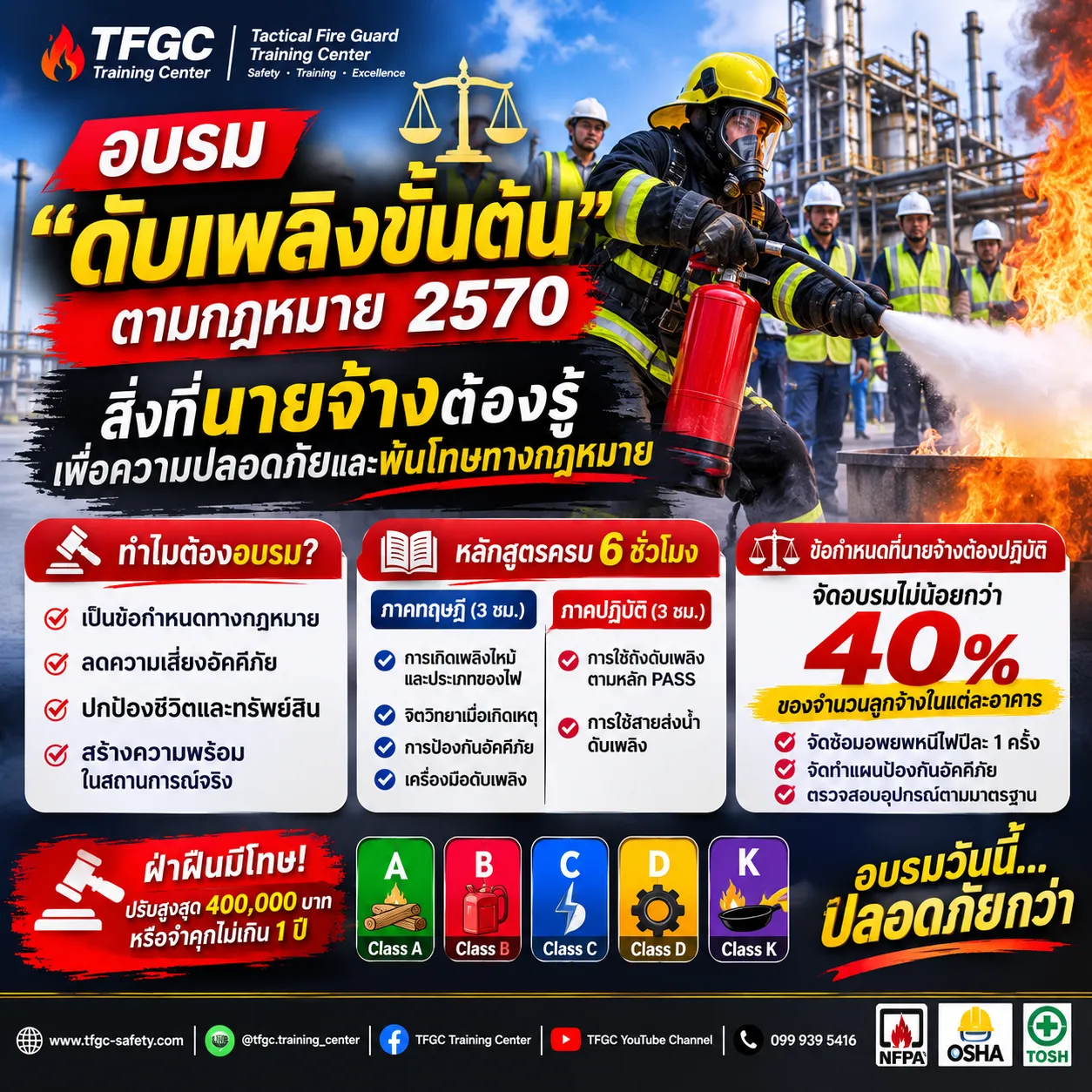
กฎหมายกำหนดให้นายจ้างต้องจัดอบรมดับเพลิงขั้นต้นแก่ลูกจ้างไม่น้อยกว่าร้อยละสี่สิบ (40%) ของจำนวนลูกจ้างในแต่ละอาคาร เพื่อสร้างทีมเผชิญหน้าระดับปฏิบัติการที่สามารถควบคุมเพลิงในระยะเริ่มต้นได้ทันทีก่อนลุกลามเป็นอัคคีภัยขนาดใหญ่
การเกิดเพลิงไหม้ในโรงงานอุตสาหกรรม อาคารสูง หรือคลังสินค้า มักเริ่มต้นจากจุดเล็กๆ เช่น ไฟฟ้าลัดวงจร ความร้อนสะสมจากกระบวนการผลิต หรือประกายไฟจากงานเชื่อมตัด หากพนักงานในพื้นที่ไม่มีความรู้ความเข้าใจในการประเมินประเภทของเชื้อเพลิงและการเลือกใช้สารดับเพลิงที่ถูกต้อง เปลวไฟขนาดเล็กจะขยายตัวจนเกินควบคุมภายในเวลาเพียง 3-5 นาที (Flashover) การฝึกอบรมจึงเป็นการสร้างแนวป้องกันด่านแรก (First Line of Defense) ที่มีประสิทธิภาพสูงสุดในการหยุดยั้งความเสียหายตั้งแต่ต้นทาง
ในระดับสากล องค์กรอย่าง OSHA (Occupational Safety and Health Administration) และมาตรฐาน NFPA (National Fire Protection Association) ได้ระบุตรงกันว่า การฝึกอบรมภาคปฏิบัติอย่างสม่ำเสมอช่วยลดอัตราการบาดเจ็บ การเสียชีวิต และมูลค่าความเสียหายของทรัพย์สินในสถานประกอบการได้อย่างมีนัยสำคัญ ซึ่งสอดคล้องกับข้อบังคับของ กองความปลอดภัยแรงงาน กรมสวัสดิการและคุ้มครองแรงงาน (Thailand Safety Dept.) ที่กำหนดมาตรฐานการฝึกอบรมดับเพลิงขั้นต้นไว้อย่างเข้มงวด
2. กฎหมายอบรมดับเพลิงขั้นต้น อาคารและโรงงาน ที่นายจ้างต้องปฏิบัติ
นายจ้างต้องปฏิบัติตามกฎกระทรวงเกี่ยวกับอัคคีภัย โดยต้องจัดอบรมให้ลูกจ้างไม่น้อยกว่า 40% ของจำนวนพนักงานในแต่ละอาคาร พร้อมจัดทำแผนป้องกันและระงับอัคคีภัย และดำเนินการซ้อมอพยพหนีไฟประจำปีอย่างต่อเนื่อง
พระราชบัญญัติความปลอดภัย อาชีวอนามัย และสภาพแวดล้อมในการทำงาน พ.ศ. 2554 และกฎกระทรวงกำหนดมาตรฐานในการบริหาร จัดการ และดำเนินการด้านความปลอดภัย อาชีวอนามัย และสภาพแวดล้อมในการทำงานเกี่ยวกับอัคคีภัย กำหนดขอบเขตหน้าที่ของนายจ้างไว้อย่างชัดเจนดังนี้:
- สัดส่วนผู้เข้ารับการอบรม: ต้องจัดให้ลูกจ้างในแต่ละหน่วยงานหรือแต่ละอาคารเข้ารับการฝึกอบรมการดับเพลิงขั้นต้นไม่น้อยกว่าร้อยละ 40 ของจำนวนลูกจ้างทั้งหมดในอาคารนั้น
- การรับรองของหน่วยฝึกอบรม: หลักสูตรและวิทยากรผู้ทำการฝึกอบรมต้องได้รับใบอนุญาตขึ้นทะเบียนอย่างถูกต้องจากกรมสวัสดิการและคุ้มครองแรงงาน
- การทบทวนและฝึกซ้อมประจำปี: ต้องจัดให้ลูกจ้างทุกคนฝึกซ้อมดับเพลิงและฝึกซ้อมอพยพหนีไฟพร้อมกันอย่างน้อยปีละ 1 ครั้ง
- มาตรฐานอุปกรณ์ประจำสถานประกอบการ: ต้องติดตั้งเครื่องดับเพลิงแบบเคลื่อนย้ายได้ (Portable Fire Extinguishers) ที่ได้มาตรฐานตามข้อกำหนด ISO (International Organization for Standardization) และตรวจสอบสภาพความพร้อมใช้งานเป็นประจำทุกเดือน
| หัวข้อข้อกำหนดทางกฎหมาย | รายละเอียดข้อบังคับสำหรับนายจ้าง | บทลงโทษ / ผลกระทบหากไม่ปฏิบัติตาม |
| จำนวนคนที่ต้องอบรมดับเพลิงขั้นต้นตามกฎหมาย | ไม่น้อยกว่า 40% ของจำนวนลูกจ้างในแต่ละอาคาร | ความผิดตาม พ.ร.บ. ความปลอดภัยฯ ปรับสูงสุดไม่เกิน 400,000 บาท หรือจำคุกไม่เกิน 1 ปี หรือทั้งจำทั้งปรับ |
| หลักสูตรดับเพลิงขั้นต้น กี่ชั่วโมง | ภาคทฤษฎีและภาคปฏิบัติรวมไม่น้อยกว่า 6 ชั่วโมง (ตามเกณฑ์มาตรฐานหลักสูตร) | ใบรับรองไม่ผ่านการรับรองจากพนักงานตรวจแรงงาน |
| การฝึกซ้อมอพยพหนีไฟประจำปี | จัดซ้อมใหญ่หนีไฟและระงับอัคคีภัยอย่างน้อยปีละ 1 ครั้ง | ไม่ผ่านเกณฑ์การตรวจประเมินความปลอดภัยประจำปี และเสี่ยงถูกสั่งระงับการใช้พื้นที่ |
| การจัดทำรายงานผล | จัดทำรายงานผลการฝึกซ้อมยื่นต่ออธิบดีหรือผู้ซึ่งอธิบดีมอบหมายภายใน 30 วัน | มีความผิดฐานไม่ปฏิบัติตามขั้นตอนและระยะเวลาที่กฎหมายกำหนด |
3. โครงสร้างหลักสูตรอบรมดับเพลิงขั้นต้น นายจ้างต้องรู้
หลักสูตรอบรมดับเพลิงขั้นต้นที่ได้มาตรฐานต้องประกอบด้วยภาคทฤษฎี (ทฤษฎีการเกิดเพลิงไหม้ ประเภทของไฟ จิตวิทยาเมื่อเกิดอัคคีภัย) และภาคปฏิบัติ (การใช้เครื่องดับเพลิงแบบต่างๆ และการใช้สายส่งน้ำดับเพลิง) รวมระยะเวลาไม่น้อยกว่า 6 ชั่วโมง
การฝึกอบรมที่มีประสิทธิภาพจะต้องทำให้ผู้เข้าอบรมเข้าใจองค์ประกอบ 4 ประการของการเกิดไฟ (Fire Tetrahedron) ได้แก่ เชื้อเพลิง (Fuel) ความร้อน (Heat) ออกซิเจน (Oxygen) และปฏิกิริยาลูกโซ่ทางเคมี (Chemical Chain Reaction) โดยเนื้อหาหลักสูตรแบ่งออกเป็น 2 ส่วนสำคัญ ดังนี้:
3.1 ภาคทฤษฎี (3 ชั่วโมง)
- ทฤษฎีการเกิดเพลิงไหม้และการแบ่งประเภทของไฟ: การจำแนกประเภทของเพลิงไหม้ตามมาตรฐานสากล NFPA 10 ได้แก่ Class A (เชื้อเพลิงธรรมดา), Class B (ของเหลวและก๊าซไวไฟ), Class C (อุปกรณ์ไฟฟ้าที่มีกระแสไฟฟ้า), Class D (โลหะติดไฟ) และ Class K (น้ำมันประกอบอาหาร)
- จิตวิทยาเมื่อเกิดอัคคีภัย: การควบคุมสติ การประเมินสถานการณ์ และการตัดสินใจภายใต้ภาวะกดดัน
- การป้องกันแหล่งกำเนิดของการติดไฟ: มาตรการควบคุมความร้อน ประกายไฟ และไฟฟ้าสถิตในสถานประกอบการ
- เครื่องมือดับเพลิงชนิดต่างๆ และวิธีการใช้งาน: กลไกการทำงานของถังดับเพลิงชนิดผงเคมีแห้ง (Dry Chemical), ก๊าซคาร์บอนไดออกไซด์ (CO2), โฟม (Foam) และสารสะอาด (Clean Agent)
3.2 ภาคปฏิบัติ (3 ชั่วโมง)
- การฝึกดับเพลิงประเภท A, B และ C: การเข้าเผชิญเหตุ การดูทิศทางลม และการใช้เทคนิค PASS (Pull, Aim, Squeeze, Sweep) กับถังดับเพลิงชนิดต่างๆ ในสถานการณ์ไฟจริง
- การฝึกใช้สายส่งน้ำดับเพลิง (Fire Hose): การคลี่สาย การจับหัวฉีดน้ำดับเพลิง การปรับรูปแบบลำน้ำ (ลำตรงและม่านน้ำ) และการประสานงานเป็นทีม
| ประเภทของไฟ (Fire Class) | ลักษณะเชื้อเพลิง | สารดับเพลิงที่เหมาะสมที่สุด | สารดับเพลิงที่ห้ามใช้เด็ดขาด |
| Class A | ไม้ กระดาษ ผ้า ยาง พลาสติก | น้ำ, โฟม, ผงเคมีแห้ง (ABC) | – |
| Class B | น้ำมันเชื้อเพลิง ทินเนอร์ ก๊าซไวไฟ | โฟม, ผงเคมีแห้ง (BC/ABC), CO2 | น้ำลำตรง (ทำให้ไฟกระจายตัว) |
| Class C | ตู้ควบคุมไฟฟ้า มอเตอร์ หม้อแปลง | ก๊าซคาร์บอนไดออกไซด์ (CO2), สารสะอาด | น้ำ, โฟม (เสี่ยงต่อการถูกไฟฟ้าดูด) |
| Class D | โลหะติดไฟ เช่น แมกนีเซียม ไทเทเนียม | ผงเคมีแห้งชนิดพิเศษสำหรับโลหะ (Class D) | น้ำ, CO2 (เกิดปฏิกิริยารุนแรงและระเบิด) |
| Class K | น้ำมันพืชและไขมันสัตว์ในห้องครัว | สารเคมีเปียก (Wet Chemical) | น้ำ (เกิดการระเบิดของไอน้ำและน้ำมันกระเด็น) |
4. มุมมองเชิงลึกที่คนอื่นมองข้าม (What Others Miss) ในการจัดอบรมดับเพลิงขั้นต้น
ความผิดพลาดส่วนใหญ่ของสถานประกอบการคือการเลือกหลักสูตรราคาถูกที่เน้นท่องจำทฤษฎีและจุดไฟในถาดเล็กๆ แบบเดิมๆ โดยไม่จำลองสถานการณ์หน้างานจริง ทำให้พนักงานตื่นตระหนกและใช้งานอุปกรณ์ไม่เป็นเมื่อเกิดเหตุเพลิงไหม้จริง
หลายองค์กรมักมองว่าการจัดอบรมดับเพลิงขั้นต้นเป็นเพียงการซื้อ “ใบรับรอง” เพื่อให้ผ่านการตรวจของเจ้าหน้าที่ แต่จากประสบการณ์หน้างานของผู้เชี่ยวชาญด้านวิศวกรรมป้องกันอัคคีภัย พบช่องโหว่สำคัญที่มักถูกมองข้ามดังนี้:
- ความไม่สอดคล้องกับความเสี่ยงเฉพาะของโรงงาน: โรงงานผลิตชิ้นส่วนยาง คลังเก็บสารเคมี โรงพยาบาล หรือโรงงานที่มีการติดตั้งระบบโซลาร์รูฟท็อป (Solar Rooftop) และสถานีชาร์จรถยนต์ไฟฟ้า (EV Charger) มีพฤติกรรมของไฟที่ซับซ้อนกว่าไฟทั่วไป การอบรมแบบเหมารวมโดยไม่ปรับเนื้อหาให้ตรงกับบริบทหน้างาน ทำให้พนักงานไม่สามารถรับมือกับความเสี่ยงจริงได้
- การฝึกในสภาวะไร้แรงกดดัน (Lack of Stress Inoculation): การเดินถือถังดับเพลิงไปฉีดไฟในถาดกลางแจ้งที่มีแสงสว่างเพียงพอ แตกต่างอย่างสิ้นเชิงกับเหตุเพลิงไหม้จริงที่มีกลุ่มควันหนาทึบ ความร้อนสูง เสียงสัญญาณเตือนภัยดังสนั่น และความมืด หากผู้เข้าอบรมไม่เคยผ่านการจำลองสถานการณ์ทับซ้อน (Realistic Scenario Simulation) สมองจะเกิดภาวะชะงักงัน (Freeze Response) ทันทีที่เจอเหตุจริง
- การละเลยทักษะการประเมินจุดวิกฤต (Point of No Return): พนักงานต้องรู้ว่าเมื่อไหร่ควรสู้และเมื่อไหร่ควรถอย หากเปลวไฟสูงเกินระดับศีรษะ ควันเริ่มปกคลุมเส้นทางหนีไฟ หรือถังดับเพลิงใบแรกหมดลงโดยไฟยังไม่สงบ พนักงานต้องอพยพทันที
5. ข้อผิดพลาดที่พบบ่อยและวิธีแก้ไข (Common Pitfalls & Myths)
ความเข้าใจผิดที่ว่า “อบรมครั้งเดียวใช้ได้ตลอดไป” หรือ “ให้พนักงานดูวิดีโอย้อนหลังแทนการฝึกปฏิบัติ” คือกับดักทางกฎหมายที่ทำให้นายจ้างต้องรับโทษปรับและสูญเสียความคุ้มครองจากบริษัทประกันภัย
- ความเชื่อที่ผิดที่ 1: “พนักงานเก่าที่เคยอบรมไปแล้ว ไม่ต้องอบรมซ้ำอีก”
- วิธีแก้ไขที่ถูกต้อง: แม้กฎหมายจะระบุสัดส่วน 40% ต่ออาคาร แต่ในทางปฏิบัติพนักงานมีการลาออก ย้ายแผนก และความจำของมนุษย์ย่อมเสื่อมถอย (Skill Decay) นายจ้างจึงควรจัดอบรมทบทวนประจำปีและหมุนเวียนพนักงานใหม่เข้ารับการอบรมให้สัดส่วนเกิน 40% อยู่เสมอ
- ความเชื่อที่ผิดที่ 2: “จัดอบรมออนไลน์ 100% เพื่อประหยัดเวลาการผลิต”
- วิธีแก้ไขที่ถูกต้อง: การอบรมดับเพลิงขั้นต้นตามกฎหมายบังคับให้ต้องมี “ภาคปฏิบัติจริง” ผู้เข้าอบรมต้องได้จับสลัก บีบคันบีบ และฉีดสารดับเพลิงด้วยตนเอง การอบรมออนไลน์เพียงอย่างเดียวไม่สามารถใช้ออกใบรับรองที่ถูกต้องตามกฎหมายได้
- ความเชื่อที่ผิดที่ 3: “จ้างวิทยากรอิสระที่ไม่มีสังกัดหน่วยฝึกอบรมมาเซ็นรับรอง”
- วิธีแก้ไขที่ถูกต้อง: ตรวจสอบใบอนุญาตของศูนย์ฝึกอบรมและรายชื่อวิทยากรทุกครั้ง ต้องเป็นหน่วยงานที่ได้รับใบอนุญาตจากกรมสวัสดิการและคุ้มครองแรงงานเท่านั้น มิฉะนั้นเอกสารทั้งหมดจะถือเป็นโมฆะ
6. ตัวอย่างสถานการณ์จริง / กรณีศึกษา (Real-World Scenario)
กรณีศึกษาจากโรงงานอุตสาหกรรมในพื้นที่ภาคตะวันออกแสดงให้เห็นว่า พนักงานที่ผ่านการอบรมภาคปฏิบัติแบบจำลองสถานการณ์จริงสามารถระงับเหตุเพลิงไหม้ได้ภายใน 30 วินาทีแรก ป้องกันความเสียหายระดับร้อยล้านบาท
กรณีศึกษาที่ 1: เหตุไฟฟ้าลัดวงจรในตู้ควบคุมหลัก (Main Electrical Panel)
- สถานการณ์: ในโรงงานผลิตชิ้นส่วนยานยนต์ในนิคมอุตสาหกรรมจังหวัดระยอง เกิดประกายไฟและกลุ่มควันพวยพุ่งออกจากตู้ควบคุมไฟฟ้าหลักระหว่างกะกลางคืน ซึ่งเป็นเพลิงประเภท Class C
- การตอบสนอง: พนักงานควบคุมเครื่องจักร 2 คนที่เพิ่งผ่านการฝึกอบรมดับเพลิงขั้นต้นแบบจำลองสถานการณ์จริง ประเมินสถานการณ์ทันทีว่าห้ามใช้น้ำเด็ดขาด คนหนึ่งรีบไปตัดเบรกเกอร์หลักของโซนนั้น ขณะที่อีกคนคว้าถังดับเพลิงก๊าซคาร์บอนไดออกไซด์ (CO2) ดึงสลักและฉีดพ่นเข้าที่ฐานของเปลวไฟภายในเวลา 30 วินาที
- ผลลัพธ์: เพลิงสงบลงอย่างรวดเร็ว ความเสียหายจำกัดอยู่เพียงชุดเบรกเกอร์ภายในตู้เดียว สายการผลิตสามารถซ่อมบำรุงและกลับมาเดินเครื่องได้ภายใน 2 ชั่วโมง ป้องกันความเสียหายต่อเครื่องจักรหลักมูลค่ากว่า 150 ล้านบาท
กรณีศึกษาที่ 2: เหตุเพลิงไหม้จากน้ำมันหล่อลื่นในไลน์ผลิต
- สถานการณ์: ท่อส่งน้ำมันไฮดรอลิกแรงดันสูงเกิดการรั่วซึมและกระเด็นไปโดนท่อไอเสียเครื่องจักรที่มีความร้อนสูง ทำให้เกิดเพลิงลุกไหม้บนพื้นโรงงาน (Class B)
- การตอบสนอง: หัวหน้างานในพื้นที่ใช้ถังดับเพลิงชนิดผงเคมีแห้ง (Dry Chemical) ฉีดกวาดคลุมพื้นที่ผิวของน้ำมันที่ติดไฟจากด้านหน้าไปด้านหลังเพื่อตัดออกซิเจน พร้อมประสานงานทีมฉุกเฉินประจำโรงงานเข้าควบคุมพื้นที่
- ผลลัพธ์: ควบคุมเพลิงได้ก่อนที่จะลุกลามไปยังถังเก็บน้ำมันสำรอง ไม่มีพนักงานได้รับบาดเจ็บแม้แต่รายเดียว
7. Actionable Checklist: วิธีจัดอบรมดับเพลิงขั้นต้นให้ถูกต้องตามกฎหมาย
รายการตรวจสอบ 6 ขั้นตอนสำหรับนายจ้างและเจ้าหน้าที่ความปลอดภัยในการทำงาน (จป.) เพื่อเตรียมความพร้อมและดำเนินการจัดอบรมได้อย่างราบรื่นและถูกต้อง 100%
- [ ] 1. คำนวณสัดส่วนพนักงาน (40% Rule): ตรวจสอบรายชื่อพนักงานปัจจุบันในแต่ละอาคาร แยกตามกะการทำงาน (กะเช้า/กะดึก) เพื่อให้มั่นใจว่าทุกกะมีผู้ผ่านการอบรมเพียงพอ
- [ ] 2. ตรวจสอบคุณสมบัติศูนย์ฝึกอบรม: ขอสำเนาใบอนุญาตเป็นหน่วยฝึกอบรมการดับเพลิงขั้นต้นจากกรมสวัสดิการและคุ้มครองแรงงาน และตรวจสอบรายชื่อวิทยากรผู้สอน
- [ ] 3. แจ้งข้อมูลความเสี่ยงหน้างานแก่ศูนย์ฝึกฯ: ส่งข้อมูลประเภทเชื้อเพลิง สารเคมี และลักษณะอาคารให้วิทยากรล่วงหน้า เพื่อออกแบบสถานการณ์จำลองให้ตรงกับหน้างานจริง
- [ ] 4. เตรียมความพร้อมสถานที่และอุปกรณ์ฝึกซ้อม: จัดเตรียมลานโล่งที่ปลอดภัย อากาศถ่ายเทสะดวก พร้อมถังดับเพลิงสำหรับฝึกซ้อมและแหล่งน้ำสำหรับฝึกใช้สายส่งน้ำ
- [ ] 5. ควบคุมการลงทะเบียนและประเมินผล: เก็บหลักฐานการลงเวลาเรียน ภาพถ่ายการฝึกภาคทฤษฎีและภาคปฏิบัติ รวมถึงผลคะแนนสอบของพนักงานทุกคน
- [ ] 6. จัดเก็บใบรับรองและยื่นรายงานตามกำหนด: รวบรวมใบวุฒิบัตร (Certificate) เก็บไว้ในแฟ้มความปลอดภัยของบริษัท และดำเนินการยื่นรายงานผลการฝึกซ้อมต่อหน่วยงานราชการภายใน 30 วัน
8. คำถามที่พบบ่อย (FAQ)
คุณสมบัติผู้เข้าอบรมดับเพลิงขั้นต้น ต้องเป็นพนักงานตำแหน่งใดบ้าง?
ต้องเป็นลูกจ้างที่ปฏิบัติงานอยู่ในอาคารหรือสถานประกอบการนั้นๆ โดยควรคัดเลือกตัวแทนจากทุกแผนกและทุกกะการทำงาน (รวมถึงพนักงานรักษาความปลอดภัยและแม่บ้าน) ให้ได้สัดส่วนไม่น้อยกว่า 40% ของพนักงานทั้งหมดในอาคาร
หลักสูตรดับเพลิงขั้นต้น กี่ชั่วโมง จึงจะถูกต้องตามกฎหมาย?
ตามมาตรฐานหลักสูตรที่กรมสวัสดิการและคุ้มครองแรงงานกำหนด ต้องมีระยะเวลาการฝึกอบรมรวมไม่น้อยกว่า 6 ชั่วโมง โดยแบ่งเป็นภาคทฤษฎี 3 ชั่วโมง และภาคปฏิบัติ 3 ชั่วโมง
เอกสารอบรมดับเพลิงขั้นต้น แจ้งหน่วยงานไหน และต้องเก็บไว้นานเท่าไหร่?
นายจ้างต้องจัดเก็บใบรับรองการฝึกอบรมและหลักฐานการฝึกซ้อมไว้ ณ สถานประกอบการเพื่อให้พนักงานตรวจแรงงานตรวจสอบได้ตลอดเวลา ส่วนรายงานผลการฝึกซ้อมดับเพลิงและฝึกซ้อมอพยพหนีไฟประจำปี ต้องยื่นต่อสำนักงานสวัสดิการและคุ้มครองแรงงานจังหวัด (หรือกรุงเทพมหานครพื้นที่) ภายใน 30 วันนับแต่วันที่เสร็จสิ้นการฝึกซ้อม
หากบริษัทมีหลายอาคาร ต้องนับสัดส่วน 40% รวมกันหรือแยกตามอาคาร?
กฎหมายกำหนดให้นับสัดส่วนไม่น้อยกว่าร้อยละ 40 แยกตามรายอาคาร เพื่อให้มั่นใจว่าในแต่ละอาคารมีผู้มีความรู้ความสามารถในการระงับเหตุเบื้องต้นประจำอยู่ตลอดเวลา
การอบรมดับเพลิงขั้นต้น กับ ดับเพลิงขั้นสูง แตกต่างกันอย่างไร?
ดับเพลิงขั้นต้น เน้นให้พนักงานทั่วไปสามารถใช้ถังดับเพลิงและสายส่งน้ำระงับเหตุไฟขนาดเล็กในระยะเริ่มต้นได้ ส่วน ดับเพลิงขั้นสูง เป็นการฝึกเชิงลึกสำหรับทีมผจญเพลิงประจำโรงงาน (Emergency Response Team) ที่ต้องสวมชุดผจญเพลิงและเครื่องช่วยหายใจ (SCBA) เพื่อเข้าดับเพลิงในพื้นที่ปิดหรือสถานการณ์รุนแรง
ถังดับเพลิงที่ใช้ในโรงงานต้องตรวจสอบบ่อยแค่ไหน?
ต้องตรวจสอบสภาพภายนอก เกจวัดความดัน สลักนิรภัย และสายฉีด อย่างน้อยเดือนละ 1 ครั้ง และส่งตรวจสอบมาตรฐานหรือบรรจุสารดับเพลิงใหม่ตามระยะเวลาที่มาตรฐาน NFPA 10 และผู้ผลิตกำหนด
9. แหล่งอ้างอิงและมาตรฐานที่เกี่ยวข้อง (References)
- กองความปลอดภัยแรงงาน กรมสวัสดิการและคุ้มครองแรงงาน (Thailand Safety Dept.) – กฎกระทรวงกำหนดมาตรฐานในการบริหาร จัดการ และดำเนินการด้านความปลอดภัย อาชีวอนามัย และสภาพแวดล้อมในการทำงานเกี่ยวกับอัคคีภัย และรายชื่อหน่วยฝึกอบรมที่ได้รับอนุญาต
- NFPA (National Fire Protection Association) – มาตรฐานสากล NFPA 10 (Standard for Portable Fire Extinguishers) และแนวทางการฝึกอบรมความปลอดภัยด้านอัคคีภัย
- OSHA (Occupational Safety and Health Administration) – มาตรฐาน 29 CFR 1910.157 ว่าด้วยข้อกำหนดการใช้ถังดับเพลิงและการฝึกอบรมพนักงานในสถานประกอบการ
- ISO (International Organization for Standardization) – มาตรฐานสากลด้านระบบการจัดการอาชีวอนามัยและความปลอดภัย (ISO 45001) และมาตรฐานอุปกรณ์ดับเพลิง
ยกระดับมาตรฐานความปลอดภัยสถานประกอบการของคุณกับ ศูนย์ฝึกอบรมความปลอดภัยและดับเพลิงมาตรฐานสากล TFGC
ศูนย์ฝึกอบรมความปลอดภัยและดับเพลิงมาตรฐานสากล TFGC (Tactical Fire Guard Training Center) ตั้งอยู่ในจังหวัดระยอง พร้อมให้บริการฝึกอบรมหลักสูตรความปลอดภัย อาชีวอนามัย และการระงับอัคคีภัยแก่ภาคอุตสาหกรรมในพื้นที่ภาคตะวันออก นิคมอุตสาหกรรมชลบุรี ระยอง และทั่วประเทศ
- จุดเด่นของเรา: เน้นการฝึกปฏิบัติจริงด้วยการจำลองสถานการณ์ทับซ้อน เพื่อให้ผู้เข้าอบรมได้ใช้ศักยภาพเต็มรูปแบบ ปรับเนื้อหาตามหน้างานจริง รองรับโรงงานยาง, น้ำมัน, โรงพยาบาล อาคารสูง รวมถึงกลุ่มนิคมอุตสาหกรรม ครอบคลุมหลักสูตรอบรมดับเพลิงขั้นต้น, อบรมดับเพลิงขั้นสูง, Petro Fire, Chemical Fire, Electric Fire, Fire Solar, Fire EV, Fire Watch และอบรมดับเพลิงเฉพาะทาง
- ช่องทางการติดต่อ:
- Website: https://tfgc-safety.com/
- LINE Official: https://lin.ee/VJZXUjD
- YouTube: https://www.youtube.com/@TFGC_TrainingCenter
- TikTok: https://www.tiktok.com/@tfgc.training_center
- Facebook: https://www.facebook.com/search/top?q=TFGC%20Training%20Center
- เบอร์โทรติดต่อ: 099 939 5416
Basic Fire Fighting Training Law 2570: What Employers Must Know for Compliance and Workplace Safety
Implementing basic fire fighting training under updated safety regulations is far more than a bureaucratic checkbox to pass government inspections; it is a critical legal and operational responsibility for every employer and facility manager. Under current ministerial regulations on fire safety, employers are legally obligated to ensure that employees undergo certified fire suppression training and annual refresher drills. This guarantees that during an emergency, frontline personnel can extinguish incipient fires immediately, safeguarding human lives, physical assets, and long-term business continuity.
1. Why Regulations Mandate Basic Fire Fighting Training
Labor safety laws require employers to provide basic fire fighting training to at least 40 percent of employees in each building, establishing a capable frontline response team to suppress small fires before they escalate into catastrophic blazes.
Fires in manufacturing facilities, high-rise buildings, and warehouses almost always originate from localized incidents—such as electrical short circuits, thermal buildup in machinery, or hot-work sparks. Without proper training to identify fuel classes and select the correct extinguishing agent, a minor flame can reach flashover within 3 to 5 minutes. Structured training serves as the most effective first line of defense to contain hazards at the source.
Internationally, regulatory bodies like OSHA (Occupational Safety and Health Administration) and NFPA (National Fire Protection Association) emphasize that recurring hands-on training drastically reduces workplace fatalities and property losses. These global benchmarks align directly with the enforcement framework of the Thailand Safety Dept. (Department of Labour Protection and Welfare).
2. Legal Compliance and Employer Responsibilities for Factories and Buildings
Employers must comply with ministerial fire safety regulations by training at least 40% of staff per building, maintaining a formal fire prevention and suppression plan, and executing annual evacuation drills.
Under the Occupational Safety, Health, and Environment Act and corresponding ministerial regulations on fire safety management, employers are strictly required to fulfill the following obligations:
- Trained Personnel Quota: Ensure at least 40% of total employees in each individual building or facility complete certified basic fire fighting training.
- Accredited Training Providers: Engage only training centers and instructors officially licensed by the Department of Labour Protection and Welfare.
- Annual Refresher and Evacuation Drills: Conduct facility-wide fire suppression and evacuation drills at least once every calendar year.
- Certified Equipment Standards: Install and inspect portable fire extinguishers compliant with ISO (International Organization for Standardization) benchmarks on a monthly basis.
| Regulatory Requirement | Employer Compliance Details | Penalties & Consequences for Non-Compliance |
| Trained Personnel Ratio | Minimum 40% of employees per building | Fines up to 400,000 THB, imprisonment up to 1 year, or both |
| Course Duration | Minimum 6 hours combined theory and practical | Certificates rejected by labor inspectors |
| Annual Evacuation Drills | Full-scale annual fire and evacuation drill | Failure of annual safety audits; risk of operational suspension |
| Reporting Submission | Submit drill reports to authorities within 30 days | Legal penalties for procedural non-compliance |
3. Curriculum Structure and Core Training Modules
A legally compliant basic fire fighting curriculum must deliver at least 6 hours of instruction, split equally between theoretical fire science (3 hours) and hands-on suppression drills (3 hours).
Effective training builds a solid understanding of the Fire Tetrahedron—fuel, heat, oxygen, and the chemical chain reaction—structured into two core phases:
3.1 Theoretical Module (3 Hours)
- Fire Science and Classification: Categorizing fires under international NFPA 10 standards: Class A (ordinary combustibles), Class B (flammable liquids/gases), Class C (energized electrical equipment), Class D (combustible metals), and Class K (cooking oils/fats).
- Fire Psychology: Managing panic, assessing situational hazards, and making rapid decisions under acute stress.
- Ignition Source Prevention: Controlling heat, sparks, and static electricity in industrial environments.
- Extinguishing Agents and Equipment: Mechanics of Dry Chemical Powder, Carbon Dioxide (CO2), Foam, and Clean Agent extinguishers.
3.2 Practical Module (3 Hours)
- Live Fire Suppression (Class A, B, and C): Approaching fires upwind, assessing flame behavior, and executing the PASS technique (Pull, Aim, Squeeze, Sweep) on live fire props.
- Fire Hose Deployment: Unrolling fire hoses, operating nozzles (straight stream vs. fog pattern), and coordinating team-based water suppression.
| Fire Class | Fuel Type | Recommended Extinguishing Agent | Strictly Prohibited Agents |
| Class A | Wood, paper, cloth, rubber, plastics | Water, Foam, Dry Chemical (ABC) | None |
| Class B | Fuel oils, solvents, flammable gases | Foam, Dry Chemical (BC/ABC), CO2 | Straight-stream water (spreads burning liquid) |
| Class C | Electrical panels, motors, transformers | Carbon Dioxide (CO2), Clean Agents | Water, Foam (severe electrocution hazard) |
| Class D | Combustible metals (magnesium, titanium) | Specialized Class D dry powder | Water, CO2 (triggers violent explosions) |
| Class K | Cooking oils and animal fats | Wet Chemical extinguishers | Water (causes explosive steam-oil boilover) |
4. What Others Miss: Critical Gaps in Standard Fire Training
The biggest vulnerability in corporate safety programs is relying on low-cost, rote-memorization courses with minimal live-fire exposure, leaving workers frozen with panic during real emergencies.
Many organizations treat basic fire fighting training as a paper compliance exercise. However, fire protection engineering specialists identify major operational blind spots:
- Lack of Industry-Specific Customization: Rubber manufacturing plants, petrochemical facilities, hospitals, and buildings equipped with Solar Rooftop systems or EV Charging stations present complex fire dynamics. Generic training fails to prepare workers for these specialized hazards.
- Absence of Stress Inoculation: Discharging an extinguisher at a small open-air pan in broad daylight bears little resemblance to a real industrial fire filled with blinding toxic smoke, intense radiant heat, and blaring alarms. Without realistic scenario simulations, untrained brains default to a freeze response.
- Recognizing the Point of No Return: Workers must be trained to know when to fight and when to flee. If flames exceed head height, smoke blocks exit routes, or the first extinguisher empties without suppressing the fire, immediate evacuation is mandatory.
5. Common Pitfalls and Legal Myths
Assuming a single training session lasts forever, or substituting online videos for hands-on drills, are dangerous misconceptions that expose employers to severe legal liability and voided insurance coverage.
- Myth 1: “Once an employee is trained, they never need retraining.”
- Fact: Workforce turnover and natural skill decay erode readiness. Employers must conduct annual refresher drills and continuously train new hires to keep trained staff ratios well above the 40% threshold.
- Myth 2: “100% online courses satisfy legal training requirements.”
- Fact: Labor regulations explicitly mandate hands-on practical exercises with physical fire extinguishers and hoses. Online-only courses cannot legally issue valid certifications.
- Myth 3: “Any independent instructor can sign off on training certificates.”
- Fact: Both the training organization and its instructors must hold active licenses from the Department of Labour Protection and Welfare, or all certificates are legally invalid.
6. Real-World Industrial Case Studies
Field data from manufacturing facilities in Thailand’s Eastern Seaboard proves that personnel trained in realistic scenario simulations can extinguish electrical fires within 30 seconds, preventing multi-million-baht losses.
Case Study 1: Main Electrical Panel Fire in an Automotive Parts Plant
- Scenario: Sparks and thick smoke erupted from a main electrical distribution panel during a night shift in a Rayong industrial estate (Class C fire).
- Response: Two machine operators who had recently completed hands-on simulation training immediately recognized the electrical hazard, prohibited water use, isolated the zone’s main breaker, and discharged a CO2 extinguisher at the base of the flames within 30 seconds.
- Outcome: The fire was completely extinguished, confining damage to a single breaker unit. Production resumed within two hours, saving over 150 million THB in critical machinery.
Case Study 2: High-Pressure Hydraulic Oil Line Rupture
- Scenario: A ruptured hydraulic line sprayed oil onto a hot exhaust manifold, igniting a Class B pool fire on the factory floor.
- Response: A trained shift supervisor deployed a Dry Chemical extinguisher, sweeping across the burning surface from front to back to smother oxygen supply while alerting the facility’s emergency response team.
- Outcome: The blaze was contained before reaching nearby bulk oil storage tanks, resulting in zero injuries.
7. Actionable Compliance Checklist for Employers
A 6-step operational checklist for employers and Safety Officers to execute legally compliant and high-impact basic fire fighting training.
- [ ] 1. Audit the 40% Headcount Quota: Calculate employee numbers per building and across all shifts (day/night) to ensure adequate coverage.
- [ ] 2. Verify Training Center Credentials: Request copies of the provider’s official government training license and instructor certifications.
- [ ] 3. Share Site-Specific Hazard Profiles: Provide trainers with details on facility chemicals, fuels, and equipment so scenarios mirror real workplace risks.
- [ ] 4. Prepare Safe Practical Training Zones: Ensure an open, well-ventilated outdoor area equipped with practice extinguishers and water supplies.
- [ ] 5. Document Attendance and Assessments: Maintain sign-in sheets, photographic evidence of theory/practical sessions, and test scores for every participant.
- [ ] 6. Archive Certificates and File Reports: Store official certificates on-site for labor inspections and submit annual drill reports to authorities within 30 days.
8. Frequently Asked Questions (FAQ)
Who is eligible to attend basic fire fighting training?
Any employee working within the building or facility is eligible. Employers should select representatives across all departments and shifts—including security guards and janitorial staff—to exceed the 40% minimum threshold.
How many hours are required for a legally valid basic fire fighting course?
The course must total at least 6 hours, divided into 3 hours of theoretical instruction and 3 hours of practical hands-on exercises.
Where must training records and drill reports be submitted?
Certificates and training records must be kept on-site for labor inspector audits. Annual fire suppression and evacuation drill reports must be submitted to the Provincial Office of Labour Protection and Welfare within 30 days of completion.
If a company operates multiple buildings, is the 40% quota calculated overall or per building?
The law mandates that at least 40% of employees in each individual building must be trained, ensuring immediate response capability inside every structure.
What is the difference between Basic and Advanced Fire Fighting training?
Basic Fire Fighting equips general staff to suppress small, incipient fires using portable extinguishers and hoses. Advanced Fire Fighting trains dedicated Emergency Response Teams (ERT) to wear full turnout gear and Self-Contained Breathing Apparatus (SCBA) to combat severe or enclosed structural fires.
How often must workplace fire extinguishers be inspected?
Fire extinguishers must undergo visual inspections of pressure gauges, safety pins, and hoses at least once a month, alongside scheduled maintenance per NFPA 10 standards.
9. References
- Thailand Safety Dept. (Department of Labour Protection and Welfare) – Ministerial Regulations on Fire Safety Management and Accredited Training Providers.
- NFPA (National Fire Protection Association) – NFPA 10: Standard for Portable Fire Extinguishers and industrial fire safety guidelines.
- OSHA (Occupational Safety and Health Administration) – Standard 29 CFR 1910.157 covering portable fire extinguishers and employee training mandates.
- ISO (International Organization for Standardization) – ISO 45001 Occupational Health and Safety Management Systems and firefighting equipment standards.
Elevate Your Facility’s Safety Standards with TFGC International Standard Fire Safety and Training Center
TFGC (Tactical Fire Guard Training Center), located in Rayong Province, delivers premier occupational safety, health, and fire suppression training for industrial enterprises across Thailand’s Eastern Seaboard (Chonburi, Rayong) and nationwide.
- Our Strengths: Specializing in realistic, hands-on training using overlapping scenario simulations to unlock full responder potential. Courses are customized to actual site hazards—supporting rubber factories, petrochemical plants, hospitals, high-rise buildings, and industrial estates. Programs include Basic Fire Fighting, Advanced Fire Fighting, Petro Fire, Chemical Fire, Electric Fire, Solar Fire, EV Fire, Fire Watch, and specialized industrial fire courses.
- Contact Channels:
- Website: https://tfgc-safety.com/
- LINE Official: https://lin.ee/VJZXUjD
- YouTube: https://www.youtube.com/@TFGC_TrainingCenter
- TikTok: https://www.tiktok.com/@tfgc.training_center
- Facebook: https://www.facebook.com/search/top?q=TFGC%20Training%20Center
- Phone: 099 939 5416