
ในการปฏิบัติภารกิจระงับอัคคีภัยและความปลอดภัยในโรงงาน การควบคุมและการตรวจสอบแรงดันน้ำถือเป็นหัวใจสำคัญที่จะช่วยให้ระบบดับเพลิงทำงานได้อย่างเต็มประสิทธิภาพ การละเลยขั้นตอนการตรวจสอบอาจส่งผลให้อุปกรณ์ไม่สามารถส่งน้ำได้ตามเป้าหมายในนาทีวิกฤต บทความนี้จะพาท่านเจาะลึกกระบวนการ Measure Nozzle Pressure ตามหลักมาตรฐานสากล NFPA (National Fire Protection Association) เพื่อยกระดับความปลอดภัย เพิ่มความแม่นยำ และช่วยให้ผู้ปฏิบัติงานสามารถนำไปประยุกต์ใช้ในการวัดแรงดันหัวฉีดดับเพลิงในการใช้งานจริงได้อย่างมีประสิทธิภาพ
Key Takeaways: จุดสำคัญที่ต้องรู้
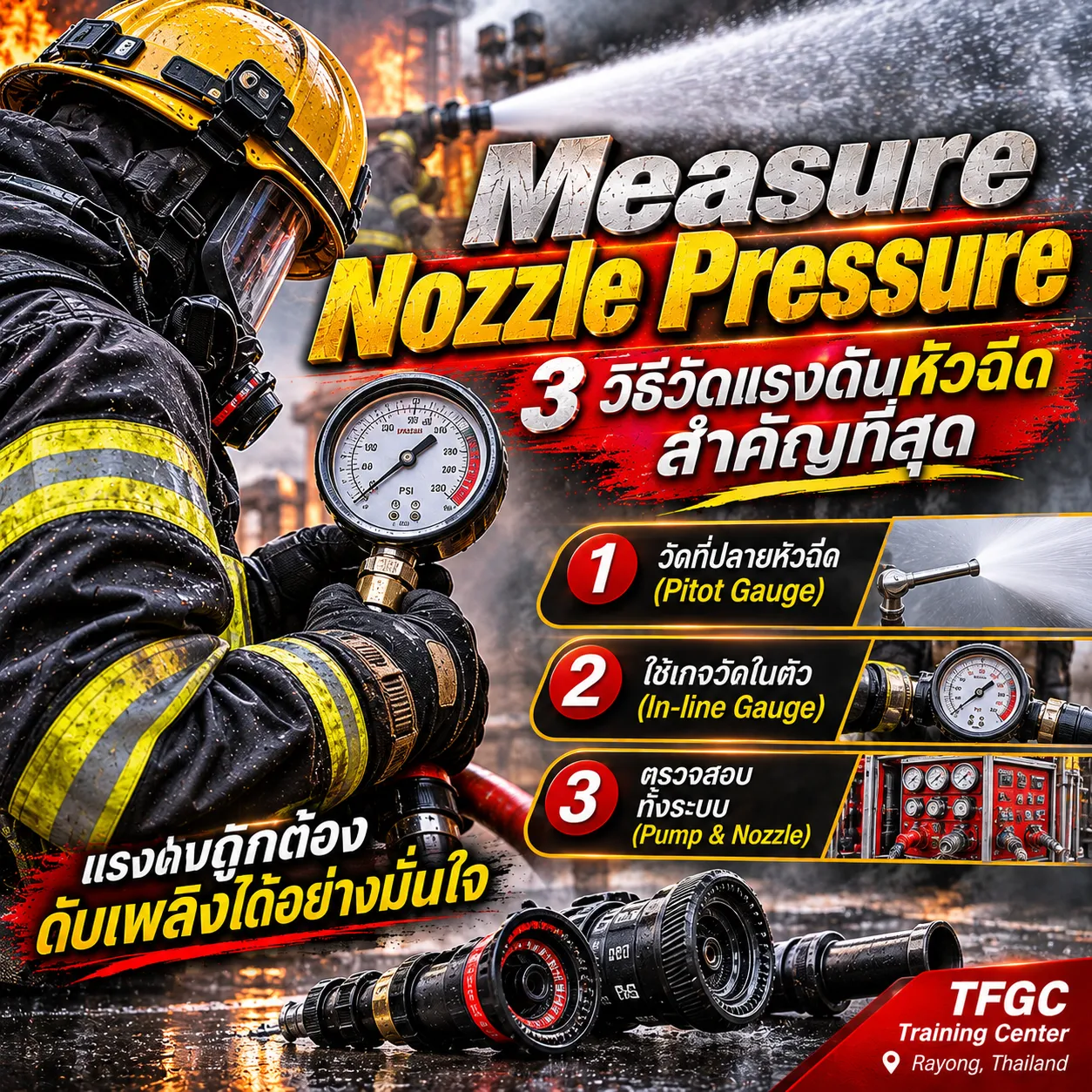
- ความสำคัญของแรงดันปลายหัวฉีด: การตรวจสอบค่าแรงดัน (PSI / Bar) ช่วยยืนยันว่าระบบส่งน้ำทำงานร่วมกับอัตราการไหล (GPM) ได้อย่างสมบูรณ์
- เครื่องมือที่เหมาะสมกับประเภทหัวฉีด: การใช้ท่อพิตอต (Pitot Gauge) สำหรับหัวฉีดลำตรง และเกจวัดแรงดันในตัว (In-line Gauge) สำหรับหัวฉีดแบบผสม (Fog Nozzle)
- การตรวจสอบสองฝั่งของระบบ: การประสานงานระหว่างเครื่องสูบน้ำและปลายหัวฉีดเป็นสิ่งสำคัญที่สุดเพื่อให้มั่นใจว่าระบบมีความพร้อมรบสูงสุด
ทำความเข้าใจแก่นแท้ของ Measure Nozzle Pressure ในการปฏิบัติงาน
เมื่อสถานประกอบการหรือทีมนักดับเพลิงต้องเตรียมความพร้อมด้านอุปกรณ์ การทำความเข้าใจเกี่ยวกับ Measure Nozzle Pressure ถือเป็นทักษะพื้นฐานที่ไม่ควรมองข้าม ตามคำแนะนำของสถาบันระดับโลกอย่าง IFSTA แรงดันที่ถูกต้องที่ปลายหัวฉีดจะช่วยให้มวลน้ำถูกส่งออกไปทำลายความร้อนได้อย่างเต็มที่
1. วิธีการใช้ท่อพิตอต (Pitot Gauge) สำหรับหัวฉีดลำตรง (Smooth Bore Nozzle)
สำหรับหัวฉีดแบบลำตรงขนาด 1.75 นิ้วที่มีปลายขนาด 7/8 นิ้ว การวัดแรงดันทางออกจะต้องใช้ท่อพิตอตสอดเข้าไปในลำน้ำที่พุ่งออกมา เพื่อยืนยันว่ามีแรงดัน 3.4 บาร์ (50 PSI) ที่สอดคล้องกับอัตราการไหลประมาณ 160 แกลลอนต่อนาที (GPM) การตรวจสอบด้วยวิธีนี้ช่วยให้วิศวกรความปลอดภัยมั่นใจได้ว่าระบบส่งน้ำทำงานได้อย่างมีประสิทธิภาพสูงสุด
2. การใช้เกจวัดแรงดันในตัว (In-line Gauge) สำหรับหัวฉีดแบบผสม (Fog Nozzle)
ในกรณีที่ใช้งานหัวฉีดแบบผสม (Combination Fog Nozzle) ซึ่งไม่สามารถใช้ท่อพิตอตวัดที่ปลายกระบอกได้โดยตรง ผู้ปฏิบัติงานจะต้องอาศัยเกจวัดแรงดันที่ติดตั้งไว้บนสายส่งน้ำ (In-line Gauge) เพื่อตรวจสอบว่ามีแรงดันฐานที่ถูกต้อง 3.4 บาร์ (50 PSI) ซึ่งสอดคล้องกับอัตราการไหล 150 GPM ตามสเปกของอุปกรณ์
ประสบการณ์ตรงจากสนามจริง: วิธีรับมือเมื่อ “ไม่มีเครื่องมือวัด” และเจอแรงดันน้ำ น้อยไป หรือ สูงไป
ในสถานการณ์หน้างานฉุกเฉินจริง นักผจญเพลิงมืออาชีพมักต้องเผชิญกับอุปสรรคที่ไม่เป็นไปตามทฤษฎี บ่อยครั้งที่เกจวัดแรงดันชำรุด สูญหาย หรือไม่มีเครื่องมือพิตอตเกจติดตัว ประสบการณ์ตรงจากทีมนักดับเพลิงสายรุกคืบมีแนวทางรับมือและสังเกตอาการหน้างานดังนี้ครับ:
1. วิธีสังเกตและรับมือเมื่อ “แรงดันน้ำน้อยเกินไป” (Low Pressure / Dead Stream)
- อาการที่สังเกตได้: ลำน้ำพุ่งออกไปแล้วตกลงพื้นเร็วเกินไป (Reach สั้น ไม่พุ่งทะลวง), หัวฉีดไม่มีแรงต้าน (รู้สึกเบามือผิดปกติ), หรือในกรณีหัวฉีดแบบผสม (Fog) ละอองน้ำไม่แตกตัวเป็นม่าน แต่กลายเป็นหยดน้ำหนาๆ ย้อยลงมา
- ประสบการณ์หน้างานและการแก้ไข:
- ใช้หลักการสัมผัสสายส่งน้ำ (Hose Feel): ให้ผู้สนับสนุนลำเลียงมือไปบีบสัมผัสสายยาง หากสายยางนิ่มยวบเหมือนไม่มีแรงดัน แสดงว่าปั๊มส่งน้ำไม่พอหรือเกิดจุดพับหักงอ (Kink)
- การแก้ปัญหาเฉพาะหน้า: ส่งสัญญาณวิทยุแจ้งพลขับรถปั๊มน้ำ (Pump Operator) ทันทีเพื่อขอเพิ่มรอบเครื่องหรือเพิ่มแรงดัน (เช่น ขอเพิ่มทีละ 0.5 ถึง 1 Bar) พร้อมกับส่งกำลังพลเดินตรวจแนวสายส่งน้ำตลอดเส้นทางเพื่อเคลียร์จุดพับหักงอหรือรอยรั่วทันที
2. วิธีสังเกตและรับมือเมื่อ “แรงดันน้ำสูงเกินไป” (High Pressure / Over-pressurized)
- อาการที่สังเกตได้: แรงปฏิกิริยาที่ปลายหัวฉีดรุนแรงจนผู้ถือหัวฉีดเอาไม่อยู่ (Nozzle Whip), สายยางตึงแข็งโป๊กจนขยับตัวหรือเลี้ยวโค้งแทบไม่ได้, หรือลำน้ำพุ่งกระจายแตกตัวเป็นฝอยละเอียดเกินไปจนแรงปะทะลดลง
- ประสบการณ์หน้างานและการแก้ไข:
- การใช้เทคนิค Grounding & Choke Up: นักดับเพลิงต้องรีบหมอบตัวลง นำเข่าข้างหนึ่งแนบติดพื้น และใช้มือจับกระชับให้ชิดข้อต่อหัวฉีดมากขึ้นเพื่อสร้างแนวแกนกระดูกสันหลัง (Spine Support) รับแรงกระแทก
- การแก้ปัญหาเฉพาะหน้า: หากแรงดันสูงเกินไปจนเสี่ยงต่อการบาดเจ็บ ห้ามฝืนสู้โดยลำพัง ให้ใช้วิธีส่งสัญญาณมือหรือวิทยุสั่งหรี่วาล์วที่รถปั๊มทันที หรือในกรณีฉุกเฉิน ให้เปิดวาล์วระบายแรงดันที่ท่อแยกน้ำ (Gated Wye) หรือขยับปรับวาล์วปิด-เปิดที่หัวฉีดช่วยอั้นแรงดันชั่วคราวอย่างระมัดระวัง
หลักการทางวิทยาศาสตร์และกลศาสตร์ของของไหล (Fluid Mechanics)
การวิเคราะห์ทางวิทยาศาสตร์ช่วยให้การตรวจสอบแรงดันมีความแม่นยำเชิงวิศวกรรม:
- พลศาสตร์ของของไหลและความดันสถิต (Fluid Dynamics & Velocity): แรงดันที่วัดได้ที่ปลายหัวฉีดสะท้อนถึงพลังงานจลน์ของมวลน้ำที่ถูกขับเคลื่อนผ่านสายส่งน้ำ การสูญเสียแรงดัน (Friction Loss) ภายในสายยางอาจเกิดขึ้นได้หากระบบปั๊มน้ำไม่ได้รับการบริหารจัดการอย่างถูกต้อง
- ความสัมพันธ์ระหว่างความดันและอัตราการไหล: ตามหลักการของเบอร์นูลลี การรักษาแรงดันปลายหัวฉีดให้อยู่ในเกณฑ์มาตรฐานจะช่วยควบคุมอัตราการไหลของน้ำให้คงที่ ส่งผลให้ประสิทธิภาพในการดับเพลิงมีความเสถียรตลอดภารกิจ
การปรับประยุกต์ใช้เพื่อความปลอดภัยในโรงงานอุตสาหกรรมและอาคารสูง
ในพื้นที่อุตสาหกรรมขนาดใหญ่ คลังเก็บสารเคมี หรือนิคมอุตสาหกรรมมาบตาพุด จังหวัดระยอง การประยุกต์ใช้กระบวนการ Measure Nozzle Pressure มีแนวทางปฏิบัติที่สำคัญดังนี้:
- การตรวจสอบระบบตู้สายส่งน้ำดับเพลิงประจำปี (Annual Hose Cabinet Testing): ทีมความปลอดภัยควรจัดให้มีการทดสอบแรงดันน้ำและอัตราการไหลของตู้สายส่งน้ำภายในอาคารสูงและคลังสินค้า เพื่อให้แน่ใจว่าแรงดันน้ำจากระบบท่อยืน (Standpipe System) ยังคงได้มาตรฐานความปลอดภัย
- การบูรณาการเข้ากับการฝึกอบรมพนักงาน: นำอุปกรณ์วัดแรงดันมาใช้จริงในการฝึกซ้อมดับเพลิงขั้นสูง เพื่อให้ทีมฉุกเฉินมีความคุ้นเคยกับการอ่านค่าและแก้ไขปัญหาแรงดันตกได้อย่างรวดเร็วตามมาตรฐานของสถาบัน TOSH
คำถามเช็กความเข้าใจในการปฏิบัติงาน (Safety Check Quiz)
- เมื่อไม่มีเครื่องมือวัด นักดับเพลิงหน้างานจะใช้จุดสังเกตใดบนสายส่งน้ำเพื่อประเมินว่าแรงดันน้ำต่ำเกินไป?
- หากเกิดปัญหาแรงดันน้ำสูงเกินไปจนผู้ถือหัวฉีดควบคุมไม่ไหว ควรปฏิบัติอย่างไรเป็นอันดับแรก?
- เครื่องมือชนิดใดที่นิยมใช้ในการวัดแรงดันที่ปลายหัวฉีดแบบ Smooth Bore Nozzle?
เซกชัน FAQ: คำถามที่พบบ่อย
- Q1: Measure Nozzle Pressure คืออะไร?
- A: คือกระบวนการวัดและตรวจสอบแรงดันน้ำที่ทางออกของหัวฉีดดับเพลิง เพื่อให้มั่นใจว่าระบบส่งน้ำทำงานร่วมกับอัตราการไหลได้อย่างมีประสิทธิภาพ
- Q2: หากไม่มีเครื่องมือวัดแรงดัน เราจะรู้ได้อย่างไรว่าแรงดันผิดปกติ?
- A: สสังเกตจากลักษณะลำน้ำที่สั้นหรือกระจายเกินไป แรงต้านที่หัวฉีดเบาหรือหนักผิดปกติ และความตึงอ่อนของสายส่งน้ำ
- Q3: มาตรฐานสากลใดที่ระบุแนวทางการตรวจสอบแรงดันนี้?
- A: ได้รับการอ้างอิงและบรรจุอยู่ในหลักสูตรสากลของ NFPA และ IFSTA
ศูนย์ฝึกอบรมความปลอดภัยและดับเพลิงมาตรฐานสากล TFGC
ศูนย์ฝึกอบรมความปลอดภัยและดับเพลิงมาตรฐานสากล TFGC (Tactical Fire Guard Training Center) ตั้งอยู่ในจังหวัดระยอง พร้อมให้บริการฝึกอบรมหลักสูตรความปลอดภัย อาชีวอนามัย และการระงับอัคคีภัยแก่ภาคอุตสาหกรรมในพื้นที่ภาคตะวันออก นิคมอุตสาหกรรมชลบุรี ระยอง และทั่วประเทศ
- จุดเด่นของเรา: เน้นการฝึกปฏิบัติจริงด้วยการจำลองสถานการณ์ทับซ้อน เพื่อให้ผู้เข้าอบรมได้ใช้ศักยภาพเต็มรูปแบบ ปรับเนื้อหาตามหน้างานจริง รองรับโรงงานยาง, น้ำมัน, โรงพยาบาล อาคารสูง รวมถึงกลุ่มนิคมอุตสาหกรรม ครอบคลุมหลักสูตรอบรมดับเพลิงขั้นต้น, อบรมดับเพลิงขั้นสูง, Petro Fire, Chemical Fire, Electric Fire, Fire Solar, Fire EV, Fire Watch และอบรมดับเพลิงเฉพาะทาง
- ช่องทางการติดต่อ:
- Website: https://tfgc-safety.com/
- LINE Official: https://lin.ee/VJZXUjD
- Facebook: TFGC Training Center
- TikTok: @tfgc.training_center
- เบอร์โทรติดต่อ: 099 939 5416
แหล่งอ้างอิงสากล: สถาบันส่งเสริมความปลอดภัย อาชีวอนามัย และสภาพแวดล้อมในการทำงาน (TOSH)
English Content Translation
Measure Nozzle Pressure: 3 Essential Steps for Accurate Firefighting Pressure Testing
In industrial safety and fire suppression operations, controlling and verifying water pressure is vital to ensuring fire suppression systems perform at peak capacity. Neglecting verification procedures can cause equipment to fail in meeting performance targets during critical moments. This article explores the process of Measure Nozzle Pressure according to international NFPA (National Fire Protection Association) standards to enhance safety, improve precision, and empower personnel to apply nozzle pressure measurement techniques accurately in actual operations.
Key Takeaways
- Importance of Nozzle Tip Pressure: Verifying pressure values (PSI / Bar) confirms that water supply systems coordinate seamlessly with flow rates (GPM).
- Appropriate Tools for Nozzle Types: Utilizing pitot gauges for smooth bore nozzles and in-line gauges for combination fog nozzles.
- Dual-End System Verification: Coordinating between pump operators and nozzle teams is crucial to ensure maximum system combat readiness.
Understanding the Core of Measure Nozzle Pressure in Operations
When industrial facilities or firefighting teams prepare equipment readiness, understanding Measure Nozzle Pressure is a fundamental skill that must not be overlooked. According to guidance from global organizations like IFSTA, accurate tip pressure ensures water masses are effectively projected to suppress thermal energy.
1. Using a Pitot Gauge for Smooth Bore Nozzles
For 1.75-inch smooth bore nozzles equipped with 7/8-inch tips, exit pressure must be measured by inserting a pitot gauge into the discharging water stream to verify a pressure of 3.4 bar (50 PSI), corresponding to a flow rate of approximately 160 gallons per minute (GPM). This verification ensures safety engineers that water delivery systems operate at maximum efficiency.
2. Using In-line Gauges for Fog Nozzles
When utilizing combination fog nozzles where pitot insertion is impractical, operators rely on in-line pressure gauges installed along the hose line to verify a baseline pressure of 3.4 bar (50 PSI), corresponding to a flow rate of 150 GPM per equipment specifications.
Real-World Experience: Handling Incorrect Pressure Without Measuring Tools
In emergency field situations, professional firefighters frequently encounter conditions deviating from theory. When pressure gauges are damaged or unavailable, experienced attack teams rely on practical field observations and handling techniques:
1. Identifying and Managing Low Pressure (Dead Stream)
- Visual Symptoms: Water streams fall prematurely (short reach), nozzles lack normal resistance, or fog streams fail to atomize properly into a protective curtain.
- Field Tactics & Correction:
- Hose Feel Principle: Support personnel check hose rigidity; limp hoses indicate insufficient pump supply or kinks.
- Immediate Action: Radio pump operators immediately to request pressure increases while sending personnel to inspect hose lines for kinks or leaks.
2. Identifying and Managing High Pressure (Over-pressurized)
- Visual Symptoms: Excessive nozzle reaction forces causing nozzle whip, rigid unbendable hose lines, or streams dispersing into fine mists prematurely.
- Field Tactics & Correction:
- Grounding and Choke Up: Operators drop low, anchor knees to the ground, and grip closer to couplings to establish spine support.
- Immediate Action: Signal pump operators via radio or hand signals to throttle down, utilize gated wye relief valves, or partially feather nozzle shut-off valves cautiously.
Scientific Principles and Fluid Mechanics
Scientific analysis ensures engineering precision in pressure verification:
- Fluid Dynamics and Velocity: Pressure measured at nozzle tips reflects the kinetic energy of water masses driven through hose lines. Friction loss within hoses can occur if water pump systems are improperly managed.
- Relationship Between Pressure and Flow Rate: Per Bernoulli’s principle, maintaining standard nozzle tip pressure stabilizes water flow rates, ensuring consistent firefighting performance throughout operations.
Adapting for Industrial Safety and High-Rises
Within large industrial plants, chemical storage terminals, or industrial estates like Map Ta Phut, Rayong Province, applying Measure Nozzle Pressure principles involves key practices:
- Annual Hose Cabinet Testing: Safety teams should conduct annual pressure and flow tests on indoor hose cabinets in high-rise buildings and warehouses to ensure standpipe system water pressure meets safety standards.
- Employee Training Integration: Incorporate pressure measurement tools into advanced firefighting drills so emergency teams become familiar with reading values and resolving pressure drop issues per TOSH standards.
Safety Check Quiz
- In the absence of measuring tools, what hose condition do firefighters observe to assess low pressure?
- What immediate action should be taken when encountering excessive high pressure that overpowers the operator?
- What tool is commonly used to measure pressure at the tip of a smooth bore nozzle?
Common Operational Errors and Corrective Actions
- Error 1: Neglecting nozzle tip pressure verification prior to operations.
- Impact: Unknown pump water delivery adequacy, risking unsuccessful fire suppression.
- Corrective Action: Mandate pressure verification using Measure Nozzle Pressure equipment during monthly equipment inspections.
- Error 2: Relying solely on pump panel pressure gauges without checking the nozzle tip.
- Impact: Friction loss in hose lines can result in actual nozzle pressure falling below requirements.
- Corrective Action: Train pump operators and nozzle teams in radio communication to cross-verify pressure values.
FAQ: Frequently Asked Questions
- Q1: What is Measure Nozzle Pressure?
- A: The process of measuring and verifying water pressure at the discharge end of a firefighting nozzle to ensure water supply coordination with flow rates.
- Q2: How can abnormal pressure be identified without measuring tools?
- A: By observing stream reach, nozzle resistance levels, and hose line rigidity.
- Q3: Which international standards specify this pressure verification guideline?
- A: Referenced and incorporated in international standards by NFPA and IFSTA.
Tactical Fire Guard Training Center (TFGC)
Tactical Fire Guard Training Center (TFGC), located in Rayong Province, provides professional safety, occupational health, and fire suppression training for industries across the Eastern region, Chonburi, Rayong, and nationwide.
- Our Strengths: Emphasis on practical hands-on training through multi-layered simulation technologies, adhering to international NFPA standards and customized to real workplace conditions—supporting rubber plants, oil facilities, hospitals, high-rise buildings, and industrial estates. Covering Basic Firefighting, Advanced Firefighting, Petro Fire, Chemical Fire, Electric Fire, Solar Fire, EV Fire, Fire Watch, and specialized firefighting courses.
- Contact Channels:
- Website: https://tfgc-safety.com/
- LINE Official: https://lin.ee/VJZXUjD
- Facebook: TFGC Training Center
- TikTok: @tfgc.training_center
- Phone: 099 939 5416
International Reference: Thailand Institute of Occupational Safety and Health (TOSH)